
Overview
Founded in 1471 when Pope Sixtus IV donated a group of ancient bronze sculptures to the people of Rome, the Capitoline Museums are widely recognized as the world’s oldest public museum. Today, their collections span more than two millennia of artistic achievement, including an outstanding group of Baroque paintings produced during Rome’s seventeenth-century golden age. This itinerary focuses on the museum’s Baroque masterpieces, highlighting the works of artists such as Caravaggio, Guido Reni, Guercino and other leading figures whose dramatic compositions, rich color, and emotional intensity defined one of the most influential periods in European art. As you move through the galleries, you will encounter some of the finest examples of Baroque painting preserved in one of Rome’s most historic cultural institutions.
Before you Go
- Book your tickets ahead of time here
- Near the entrance to the museum from the street, you will see two large flights of stairs, take the less steep, flatter stairs to get to the museum entrance.
The Entrance

At the top of the stairs will see a large statue of Marcus Aurelius on a horse, turn right and head toward the building. There will be a line on the right to buy tickets and on the left will be the entrance where they check your tickets and send you through a metal detector. Just past security there is a locker room where you can store your water bottle and other items for free. Just past the locker room you will find the stairs. Walk up two flights to get to the entrance of the Pinoteca. Walk through the sliding glass doors to start this itinerary.
Penitent Magdalene
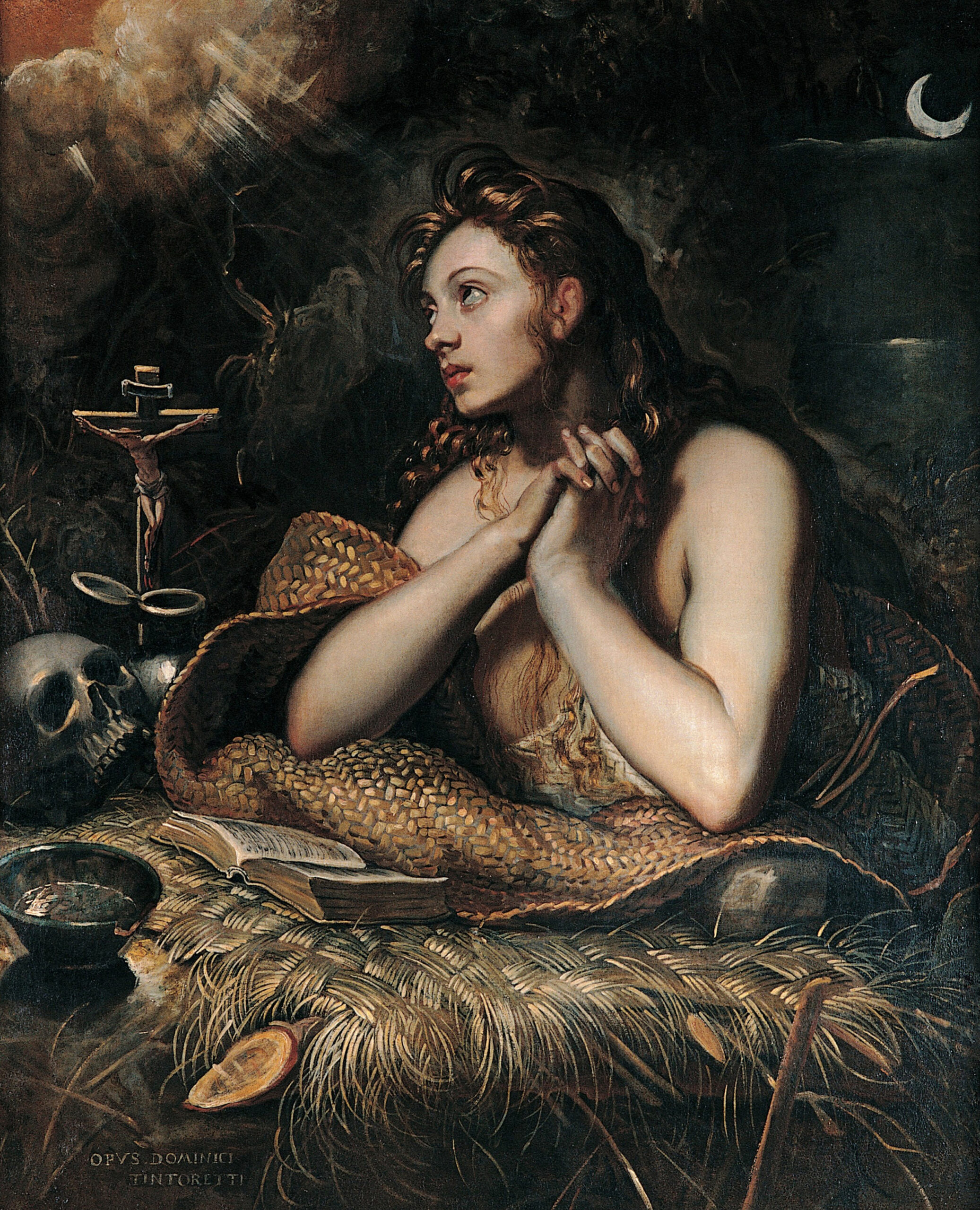
In the third, small room of the gallery, this striking painting can be found facing you on your left as you walk through. Created by Domenico Tintoretto, the talented son of the renowned Venetian master Jacopo Tintoretto, the work presents a moving and deeply human interpretation of Mary Magdalene in penitence.
Mary is shown alone in a cave, withdrawn from the distractions of the world and immersed in prayer, reflection, and repentance. The artist captures a moment of profound spiritual contemplation as she seeks reconciliation with God and meditates on her past life. Her expression is calm yet earnest, conveying both the weight of her remorse and the sincerity of her faith.
Domenico uses light with remarkable effectiveness. Against the darkness of the cave, Mary lifts her gaze upward toward a divine light that breaks through the shadows above. This radiant beam illuminates her figure, symbolizing God’s grace and mercy reaching into even the darkest places. The contrast between shadow and light serves as a visual metaphor for the Christian journey from sin to redemption. Through this heavenly illumination, the artist reminds viewers that forgiveness is always possible for those who seek it with humility and devotion.
Unlike more dramatic depictions of the saint, Domenico Tintoretto’s Magdalene is dignified and serene. Her quiet encounter with the divine invites us to share in her moment of reflection, offering a powerful message of hope, repentance, and the transformative power of forgiveness.
Make your way through one more room and turn left into the St. Petronilla hall, immediately turn left when in the hall to find the Rubens.
Finding of Romulus and Remus

Finding of Romulus and Remus (c.1612) Peter Paul Reubens.
We always joke that there isn’t an art museum in the world that doesn’t have at least 1 Rubens and the Capitoline Museum is no exception.
According to Roman legend, Rome was founded by the twin brothers Romulus and Remus in 753 BC. They were the sons of the war god Mars and the Vestal Virgin Rhea Silvia. Fearing a challenge to his power, their great-uncle Amulius ordered the infants to be cast into the River Tiber. Instead of perishing, the twins were carried safely to shore, where they were miraculously nourished by a she-wolf beneath a fig tree. They were later discovered and raised by the shepherd Faustulus and his wife.
Rubens’ painting depicts this pivotal moment in the myth: Faustulus finds the abandoned twins as they are being suckled by the she-wolf, ensuring their survival and paving the way for Rome’s future foundation. Rubens enriches the scene with symbolic figures, including Rhea Silvia, the twins’ mother, and the reclining river god Tiber, whose waters both threatened and ultimately protected the children. The prominent fig tree (Ficus Ruminalis) refers to the sacred tree associated with the legend. By focusing on the dramatic rescue rather than the later founding of the city, Rubens captures the miraculous beginning of the story from which Rome’s destiny would emerge.
Take a look on the opposite wall to see one of the highlights of the entire collection. You’ve probably been fighting the urge to admire it, but its finally time!
The Fortune Teller
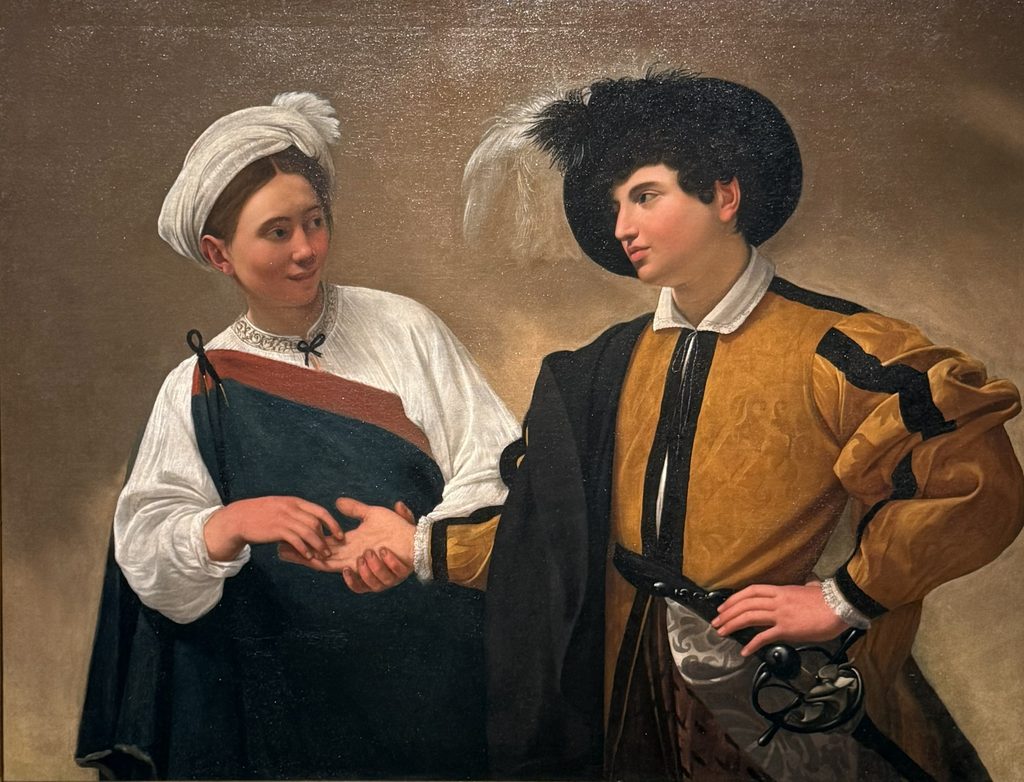
The Fortune Teller transforms an everyday street encounter into high drama: a young nobleman gazes into the eyes of a fortune teller, unaware that she is cleverly slipping a ring from his finger. I’ve seen this painting so many times in books and on the internet over the years but I was still shocked at how it immediately draws your attention away from all the other masterpieces in the room from the moment it catches your eye.To the left you will see another Caravaggio masterpiece.
St. John the Baptist with a Ram
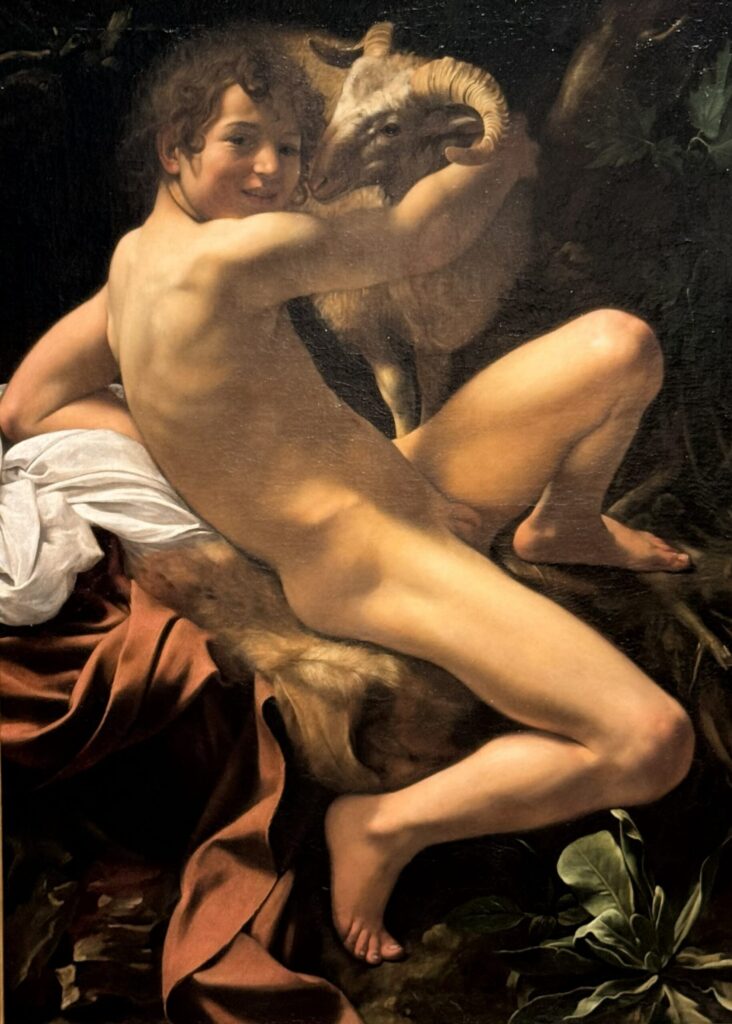
St. John the Baptist (1602) Caravaggio. In art, there have been many “interesting” depictions of St.JtB, but this is one of the most thought provoking. Why is he reclined like that? Where are is his clothes? Why is it a ram and not a lamb? Where are the other symbols we are used to seeing with St.JtB ? Why does he look so happy instead of introspective? Is it even St.JtB and not Issac (after being spared by God)?
It would be easy to dismiss this as Caravaggio simply painting a daringly sexy depiction of a Christian saint, laughing provocatively as he turns toward us. After all, Caravaggio took other unthinkable liberties with his religious paintings, so why not take it one step further?
In order to fully understand what Caravaggio was doing we must look at Michangelo’s Sistine Chapel ceiling – specifically the Sacrifice of Noah. Here we see the ignudi in the top left corner and the sacrifice of the ram in the center. The ignudi are the only non-Christian elements in the chapel and were the source of controversy in the late 16th century because the nudity was considered unbecoming.
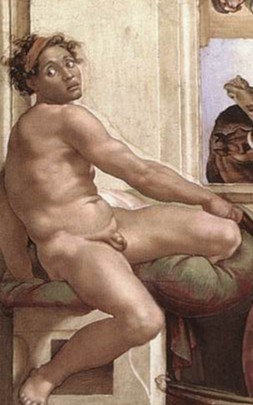
My take is that Caravaggio was commissioned by Mattei to create a painting to be dedicated to his son, Giovanni Battista Mattei. Caravaggio must have been inspired by his namesake to take elements from this portion of the ceiling to create something entirely new. The ignudi are thought of as an idealized depiction of the perfection of humanity as created by God, Caravaggio transformed that into the actual perfection of humanity depicted by his ultra-realistic version of St.JtB. He then uses the Ram instead of the lamb to reinforce the idea of sacrifice and he includes grape vines in the upper right to symbolize the body and blood of Christ. St. JtB is smiling because he knows what is coming, he knows that through the sacrifice of Jesus we will all be saved.
**Credit to Andrew Graham-Dixon for linking all of this together in his book “A life Sacred and Profane: Caravaggio”**
Turn to the left to see Guercino’s epic Altarpiece.
Burial of Saint Petronilla

One of the treasures of the Capitoline Museums, Guercino’s monumental Burial of Saint Petronilla is a masterpiece of the Roman Baroque. Painted for an altar in St. Peter’s Basilica, the enormous canvas dramatically unites earth and heaven in a single vision: below, Petronilla is laid to rest; above, she is welcomed into paradise.
Saint Petronilla was venerated in Rome as an early Christian martyr and was traditionally believed to be the daughter of Saint Peter, making her one of the city’s most beloved saints.
The painting has a remarkable story of its own. After being moved from St. Peter’s to the Quirinal Palace, it was seized by Napoleon’s troops and taken to the Louvre in Paris. Following Napoleon’s fall, the sculptor Antonio Canova helped secure its return to Italy. In 1818, the masterpiece found its new home in the Capitoline Museums, where it remains today.
Standing before this vast canvas, you’re not just seeing a great Baroque painting; you’re witnessing a survivor of history, brought back to Rome through one of the most important art restitutions of the nineteenth century.
Turn to the left and exit the room to enter Northern Italian Baroque bliss. After entering the room turn around to view one of Reni’s most famous paintings.
St. Sebastian

St. Sebastian (c.1615) Gudi Reni. Here we see one of Reni’s favorite subjects, St. Sebastian. It is thought that Cardinal Del Monte commissioned this painting. The extremely youthful saint is looking up to God knowingly, no hint of fear in his eyes despite the onslaught of arrows. This is just one of many Reni’s at the Capitoline Museum in Rome, but arguably the most famous.
Continuing to the right of St. Sebastian we see paintings from Reni’s mentors, the Carraccis.
Portrait of a Young Man

In this intimate portrait, Ludovico Carracci strips away distraction to focus entirely on the sitter. Dressed in a dark coat and broad-brimmed hat, the young figure emerges from a muted background, meeting the viewer with a direct and arresting gaze.
The painting demonstrates Carracci’s commitment to naturalism. Subtle light, restrained color, and careful modeling of the face create a sense of individuality and presence. Rather than an idealized image, this is a study of a real person, captured with remarkable honesty.
More than four centuries later, the portrait remains compelling for its simplicity, humanity, and psychological depth. Through a few carefully observed details, Carracci transforms a likeness into a timeless encounter.
Now head towards the back wall of the room for some of Reni’s final paintings.
Blessed Soul
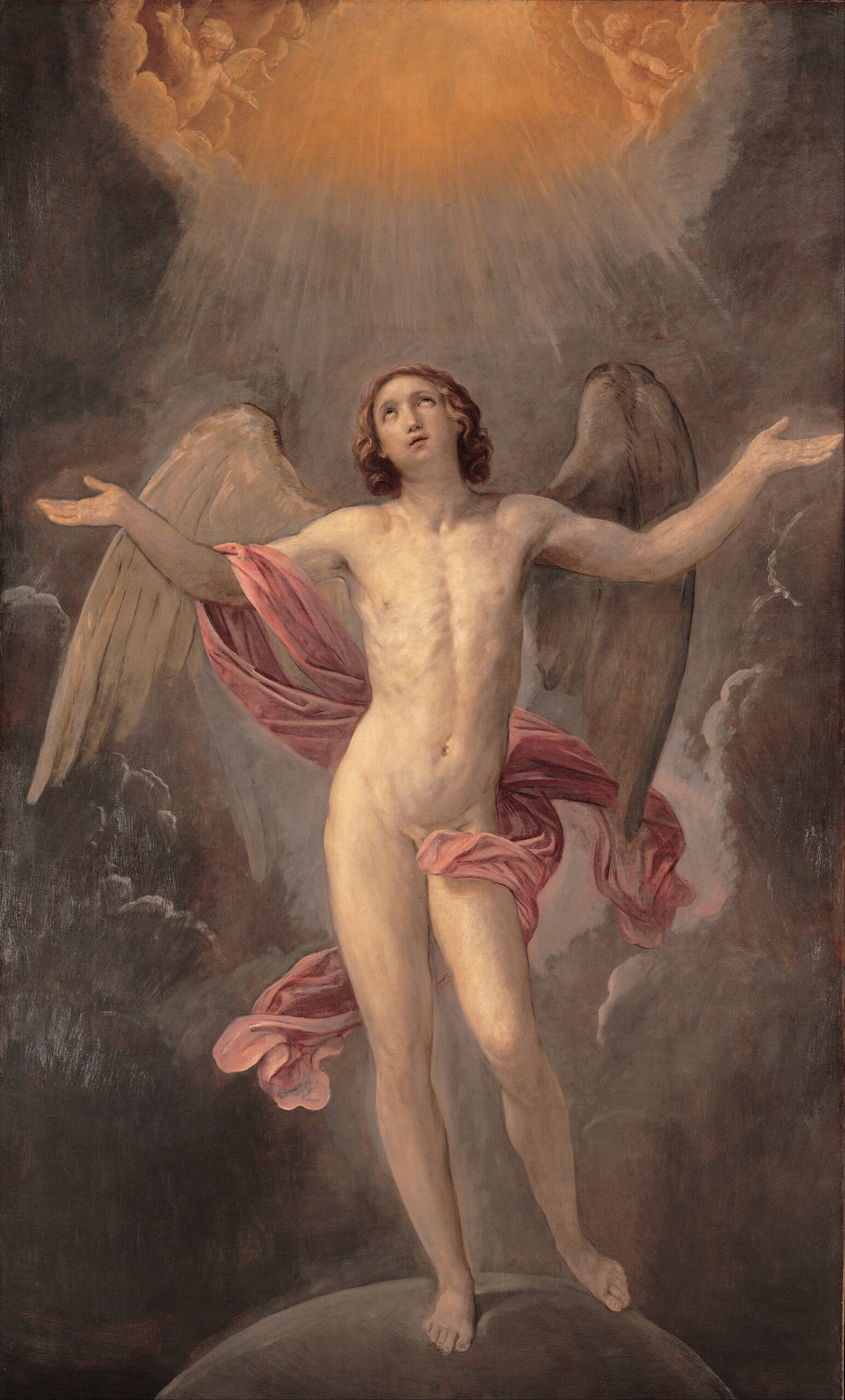
Guido Reni’s Blessed Soul is one of the most celebrated images of spiritual ecstasy in Baroque art. Suspended between earth and heaven, the winged figure gazes upward, arms outstretched toward a burst of divine light that breaks through the clouds above.
Reni achieves a remarkable sense of grace and transcendence through his elegant composition, luminous color, and idealized figure. The soft modeling of the body and the flowing rose-colored drapery create an impression of weightlessness, as if the soul is being drawn effortlessly into the presence of God.
Rather than emphasizing dramatic movement, Reni conveys spiritual transformation through beauty, serenity, and light. The painting embodies the artist’s classical style, in which harmony and emotional restraint combine to create a vision of heavenly perfection. More than a religious image, Blessed Soul is a meditation on hope, redemption, and the promise of eternal life.
To the left are more of Reni’s late work.
Reni’s Trifecta


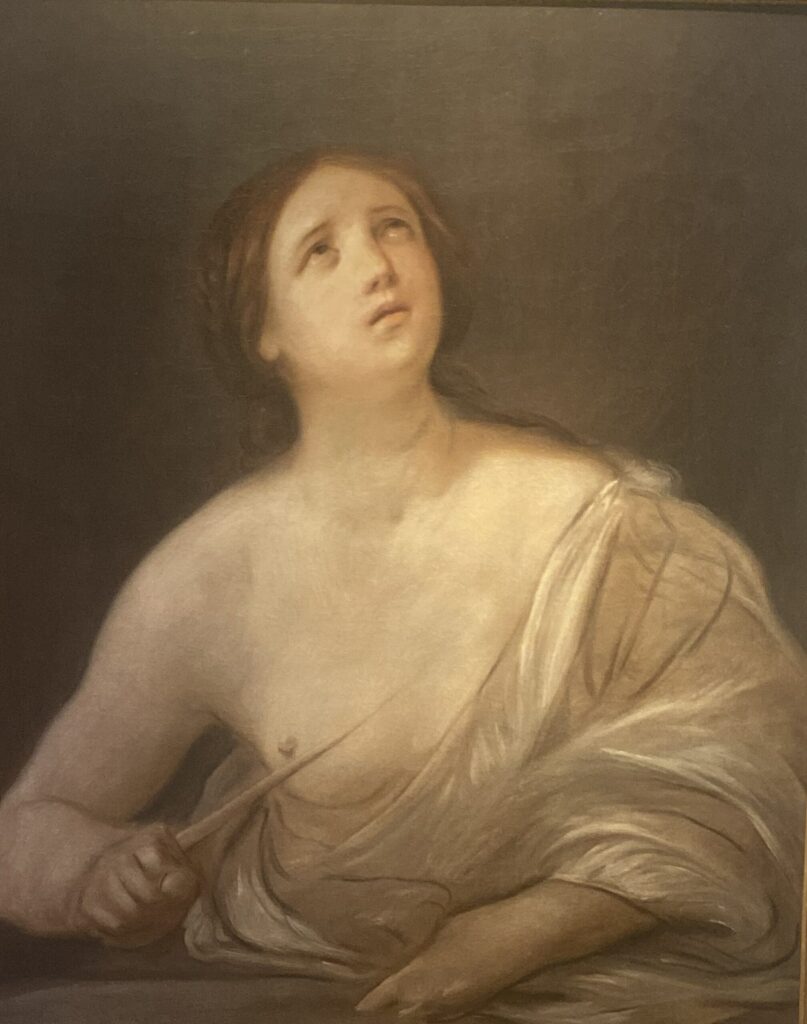
Our last look at Reni’s paintings in the museum feature his late depictions of Lucretia, Mary Magdalene, and Cleopatra (c. 1642). These three female figures were among the most popular subjects for 17th-century collectors, allowing artists to explore beauty, virtue, sacrifice, repentance, and drama through some of history’s most compelling women. They were all painted near the end of Reni’s life during what is known as his “second manner.”
Before exiting the room check out Sirani’s masterpiece.
Ulysses and Circe

Giovanni Andrea Sirani’s Ulysses and Circe (c.1650) depicts a pivotal moment in the Odyssey, where Ulysses demands that Circe transform his soldiers back into humans from their porcine state. Upon closer inspection, a pig’s head can be discerned above Ulysses’ right knee and at the bottom right of the painting.
Exit the room to find our final piece on the right.
Man and his Dog

Passarotti’s brush freezes a moment between man and beast, a bond unbroken by time. The dog’s gaze, steady and knowing, holds the weight of loyalty that outlives centuries.
This portrait, preserved in near-perfect detail, reveals a Mannerist artist whose work shaped Baroque masters. The man’s posture leans into the dog, not toward us—a world where only two lives matter.
This concludes our tour of the Capitoline Museum’s Baroque art works.
Leave a Reply