Today the Catholic Church celebrates the Assumption of the Virgin Mary. One of the fascinating things about the Assumption of the Virgin Mary is that it became one of the most important subjects in Catholic art despite not being described in the Bible. The New Testament never recounts Mary’s final moments on earth or her bodily assumption into heaven. Instead, the belief developed gradually through Christian tradition, apocryphal writings, liturgical practice, and popular devotion before eventually becoming a central feature of medieval and early modern Catholic spirituality. [britannica.com], [en.wikipedia.org]
By the Middle Ages, belief in the Assumption was widely accepted throughout Western Christianity, and artists increasingly treated it as a major subject. The feast of the Assumption had spread throughout the church, Marian devotion was flourishing, and visual representations of Mary’s heavenly destiny became a powerful way to express Catholic theology. After the Protestant Reformation challenged many traditional Marian beliefs, images of the Assumption took on even greater significance, becoming a visual statement of Catholic identity during the Baroque era. [britannica.com], [en.wikipedia.org]
Yet Baroque artists did not all agree on how to depict the event. In fact, some of the most compelling works focus not on Mary’s ascent into heaven but on her death.
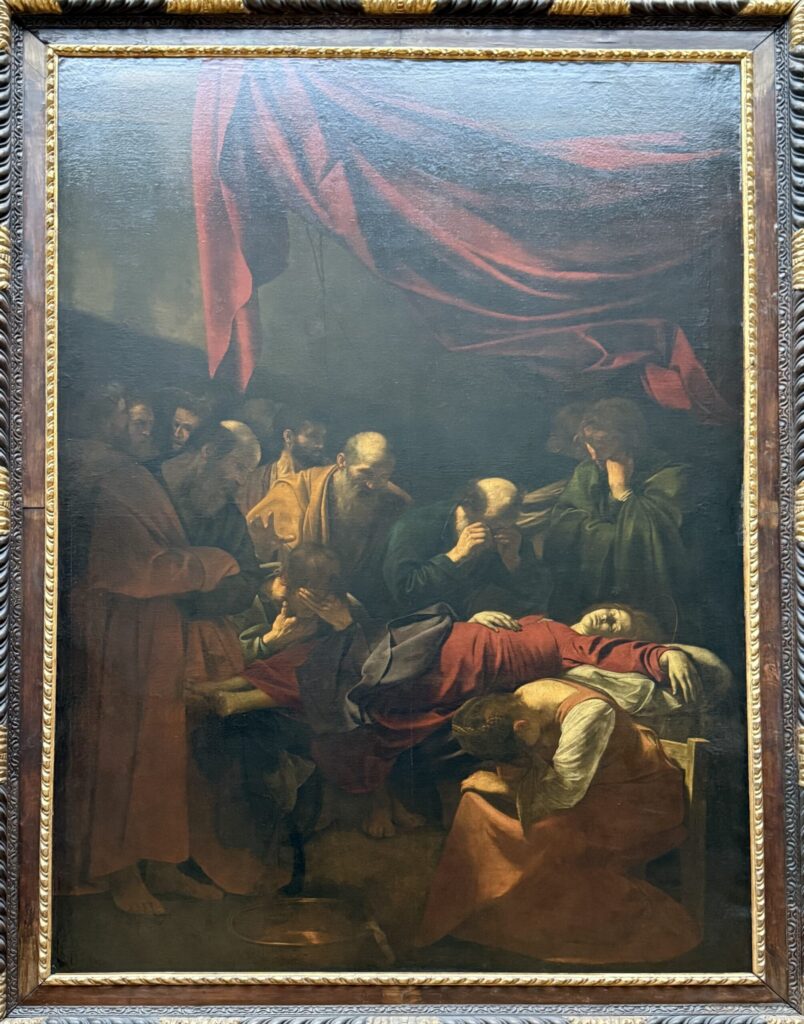
Caravaggio’s Death of the Virgin (1604-1606) is perhaps the most famous example. Rather than presenting a glorified queen of heaven surrounded by celestial light, Caravaggio shows a dead woman lying on a simple bed. Her body appears heavy and human. The apostles gather around in grief, and there is no visible miracle taking place. Caravaggio strips away the conventional symbols of sanctity and confronts viewers with the reality of death itself. Contemporary viewers were shocked by the painting’s realism, and it was ultimately rejected for its intended church setting. [en.wikipedia.org]
The irony is that this image still belongs to the story of the Assumption. Catholic tradition often held that Mary first experienced death, sometimes called the Dormition, before being taken into heaven. Caravaggio focuses entirely on that earthly moment. The heavenly conclusion is left outside the frame, inviting viewers to contemplate the mystery rather than witness it directly. [ewtn.com], [en.wikipedia.org]
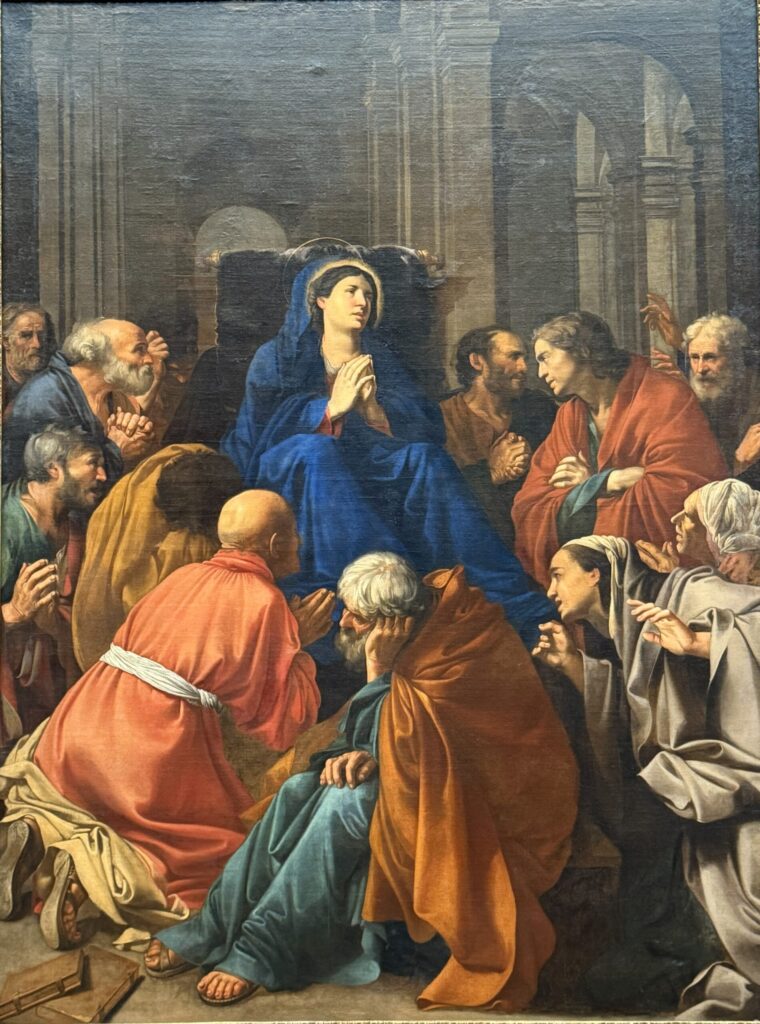
When the Carmelite church rejected Caravaggio’s painting, it commissioned a replacement from Carlo Saraceni. Saraceni’s Death of the Virgin remains grounded in the same narrative but adopts a more traditional and devotional tone. The mood is gentler, the figures more idealized, and the overall composition less confrontational. While Mary is still shown as having died, the painting makes room for a sense of sacred expectation. Unlike Caravaggio’s stark naturalism, Saraceni’s work reassures viewers that death is only a passage toward heavenly glory. [en.wikipedia.org]
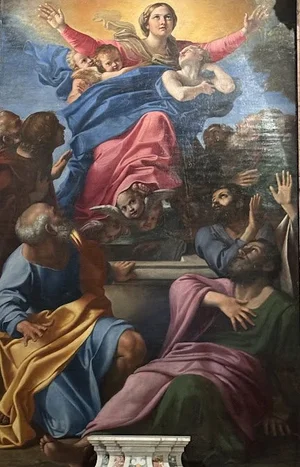
Annibale Carracci, however, took a very different approach. In works depicting the Assumption, he embraced the triumphant moment itself. Mary does not lie on a deathbed; she rises. Surrounded by clouds, angels, and divine light, she ascends toward heaven in a dynamic composition that would prove enormously influential for later Baroque painters. Carracci helped establish the classic Baroque formula: the earthly realm below, the heavenly realm above, and Mary moving between them as a bridge connecting humanity and divine grace. [en.wikipedia.org]
This contrast is what makes the Baroque treatment of the Assumption so interesting. Caravaggio and Saraceni linger on the mystery of Mary’s death, emphasizing her humanity and participation in the human condition. Carracci concentrates on the miracle’s culmination, celebrating her glorification and heavenly destiny. Both approaches reflect the same belief, but they emphasize different parts of the story.
In many ways, these artists reveal the flexibility of Catholic visual culture during the Baroque period. The Assumption was not simply a doctrine to be illustrated. It was a theological drama that could be interpreted through grief, hope, realism, or triumph. Whether Mary is shown lying lifeless among mourning apostles or soaring heavenward amid clouds and angels, the underlying message remains the same: the mother of Christ was understood to share already in the glory promised to all believers. And that belief, though absent from the pages of Scripture, became one of the defining images of Baroque art. [britannica.com], [en.wikipedia.org]
Leave a Reply