Overview
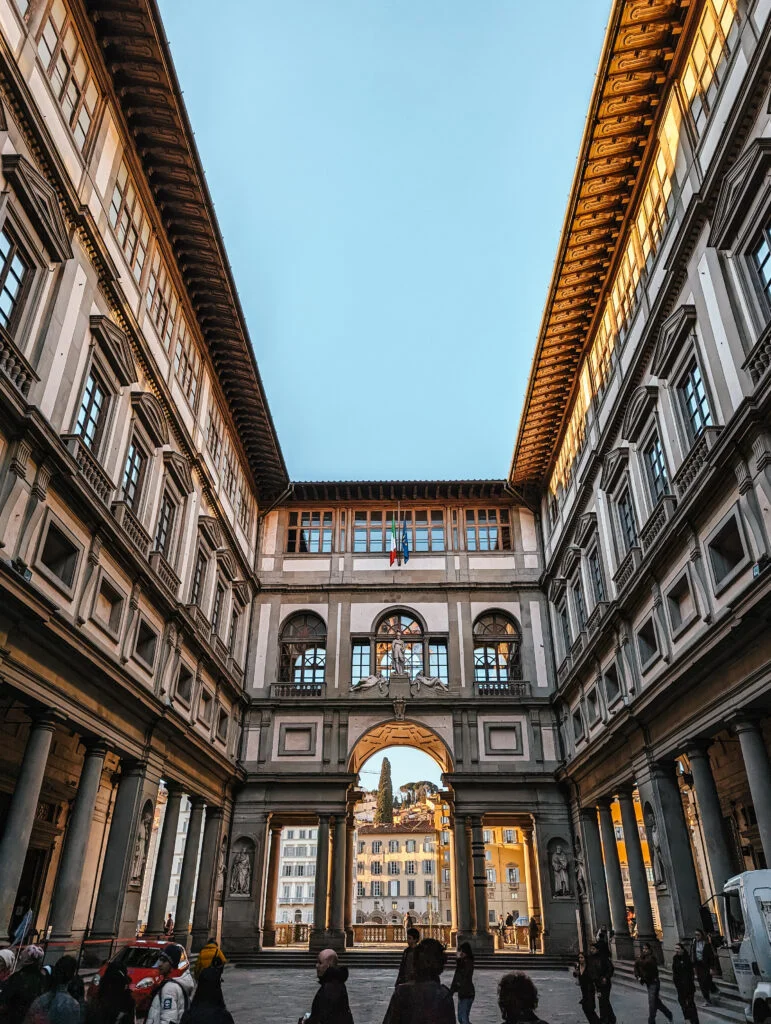
The Uffizi Galleries in Florence are home to one of the world’s most celebrated collections of Renaissance art. Housed in a historic palace designed by Giorgio Vasari, the museum traces the development of Italian painting from the Middle Ages through the modern era. Visitors can admire masterpieces by Sandro Botticelli, including The Birth of Venus and Primavera, as well as works by Leonardo da Vinci, Michelangelo, Raphael, Titian, and of course, Caravaggio. With its extraordinary collection and historic setting overlooking the Arno River, the Uffizi is an essential destination for art and history lovers.
Before You Go
The official website for the Uffizi is -> Homepage Official Website | Uffizi Galleries There are literally hundreds of fake sites out there attempting to sell tickets at uplifted prices.
We recommend going as early in the day as possible or towards closing time to reduce the number of people you will encounter in the museum. The Uffizi Gallery is known for its Renaissance Paintings so its Baroque works are considered “new” and are far less popular; which is good for us!
Because of the vast number of people that visit the gallery everyday, they have posted directional arrows that attempt to keep traffic moving in the same direction to keep things flowing through the museum. This is helpful and the first stop on the encouraged direction are the Bottecili paintings, which are the biggest draw. However, the Baroque art is the last stop on intended route. If you dont have the time or interest to see the other pieces, we recommend going against the flow a little bit and after you arrive in the musuem, near the coat check you will find the MAGLIABECHI staircase. Take that staircase up one floor and you will find the four rooms filled with Baroque masterpieces, culminating in the last room with Caravaggio’s Head of Medusa.
In the first room after walking up the staircase you will see some requisite Rubens.
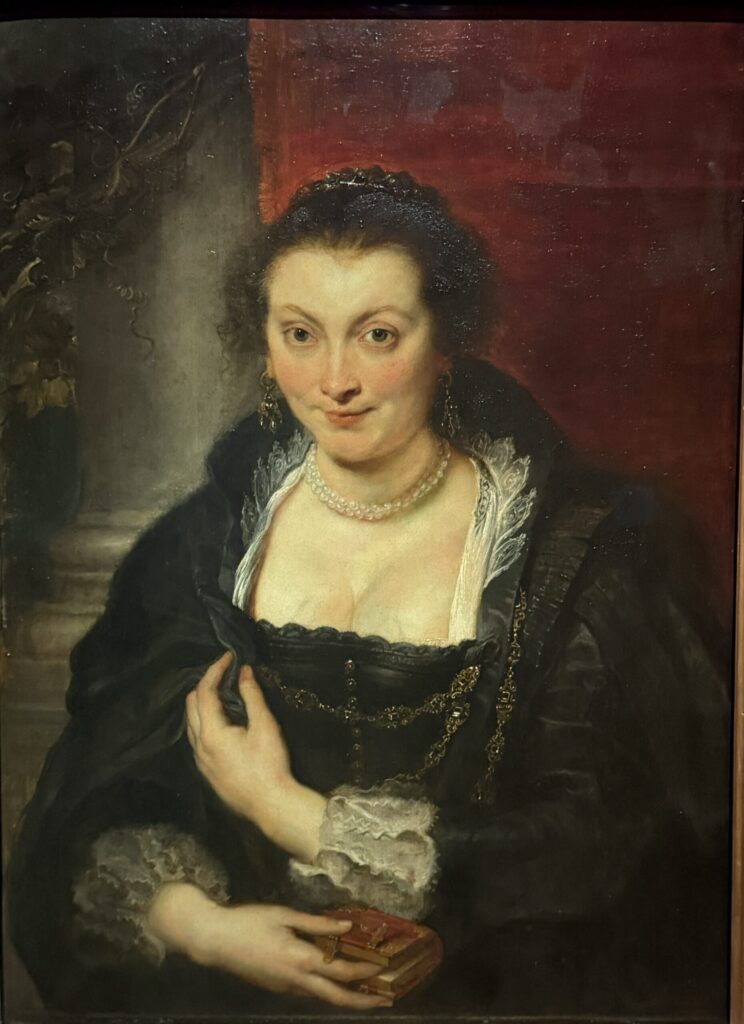
This is one of many portraits of Rubens’ first wife, Isabella Brandt. She is depicted here with a familiar, friendly, and slightly mischievous expression.
Sadly, Isabella died when she was only 34 years old, likely of the Plague.
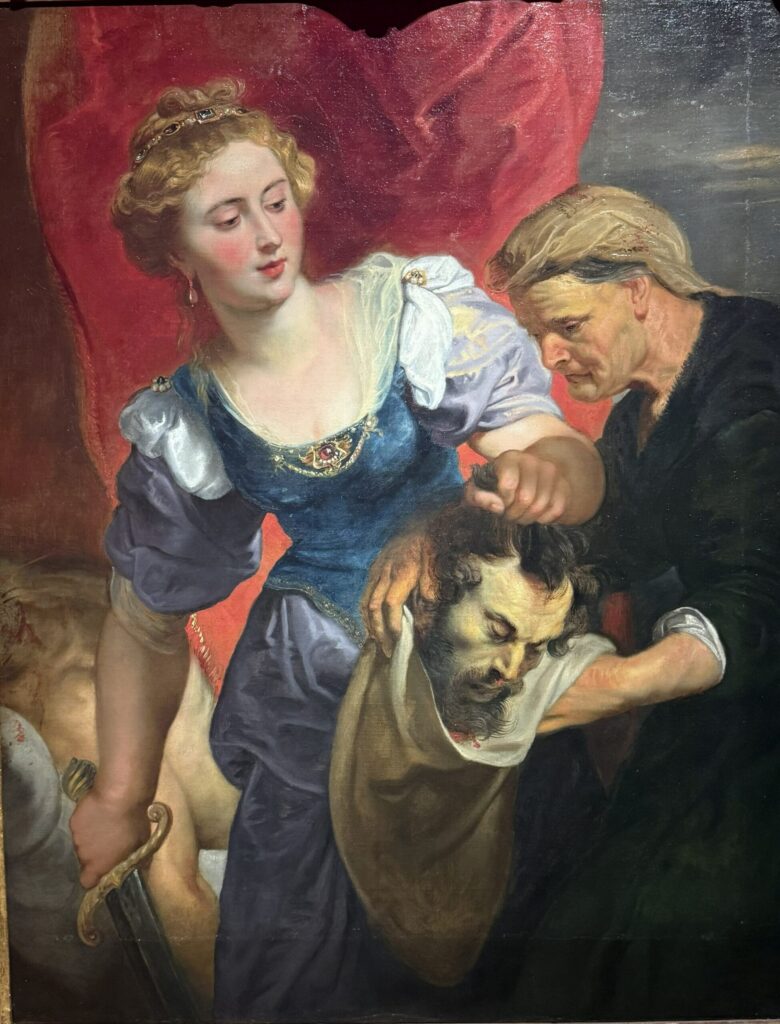
The next Rubens is an extremely popular scene in Baroque Art, Judith beheading Holofernes. The subject was popular in Baroque art because Judith represented faith, bravery, and the triumph of the seemingly powerless over tyranny. Rubens gives that message extraordinary physical energy: the figures, fabrics, and gestures seem to move beyond the boundaries of the canvas. Rubens treatment is heavy on theatricality but light on the naturalism and gore that others portray in the scene (wait til you see Artemesia’s!)
The next room features some fantastic paintings from painters known as the “Utrecht Caravaggisti”, these men from Utrecht, Netherlands studied in Rome and followed Caravaggio’s lead on the Baroque painting style.
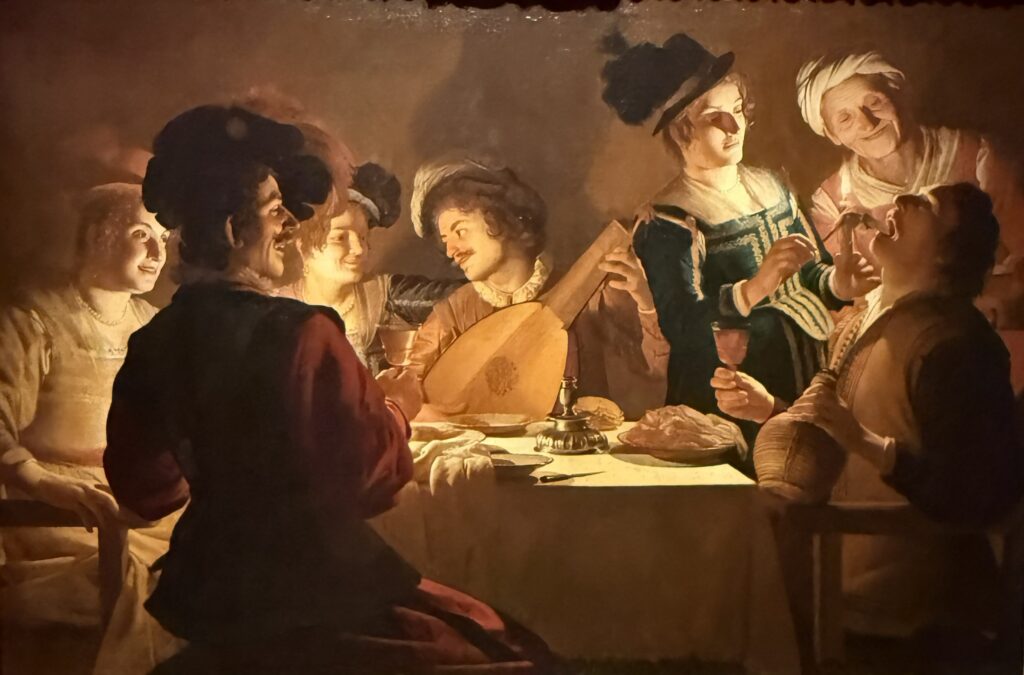
Honthorst presents a lively gathering of well-dressed people eating, flirting, and enjoying music around a lute player. On the right, a woman appears to feed a man by candlelight, emphasizing the scene’s playful intimacy. The strong contrast between light and shadow adds drama and draws attention to the figures’ gestures and expressions.
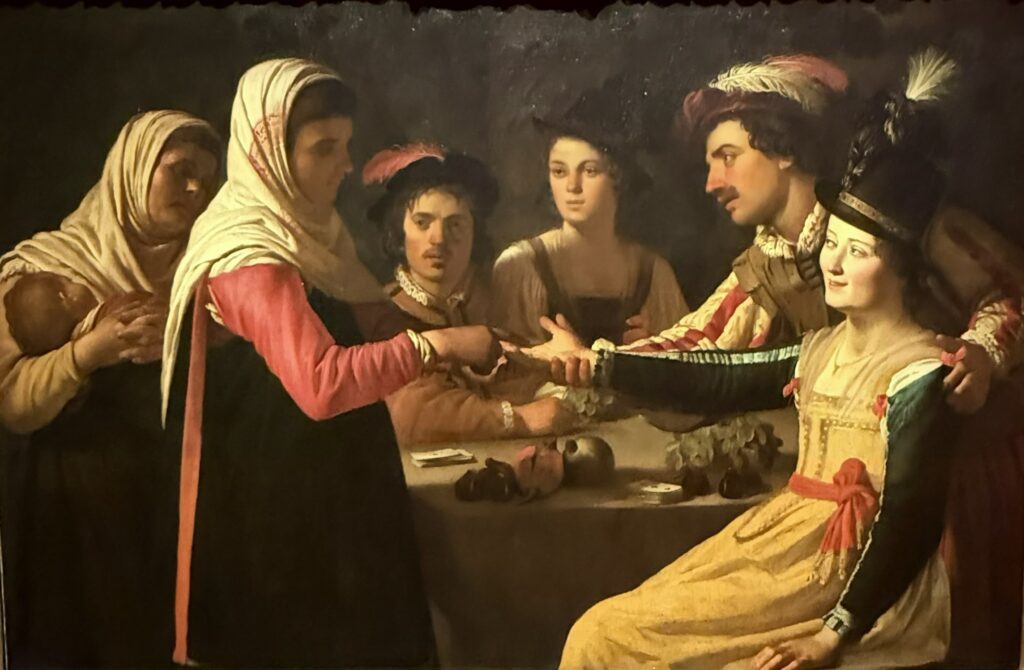
Good Fortune shows a fortune teller reading a young woman’s palm while other figures gather around them. The group’s colorful clothing, expressive gestures, and close arrangement make the scene feel like a moment observed in a busy Roman street or tavern. The fortune teller’s performance appears entertaining, but the painting also hints at deception: while the young woman is distracted by the palm reading, another figure may be preparing to take advantage of him.
Honthorst’s use of light is central to the painting. Bright illumination falls across the faces, hands, and fabrics, while the background remains dark. This technique directs our attention to the exchange taking place and gives the scene the immediacy of a staged performance.
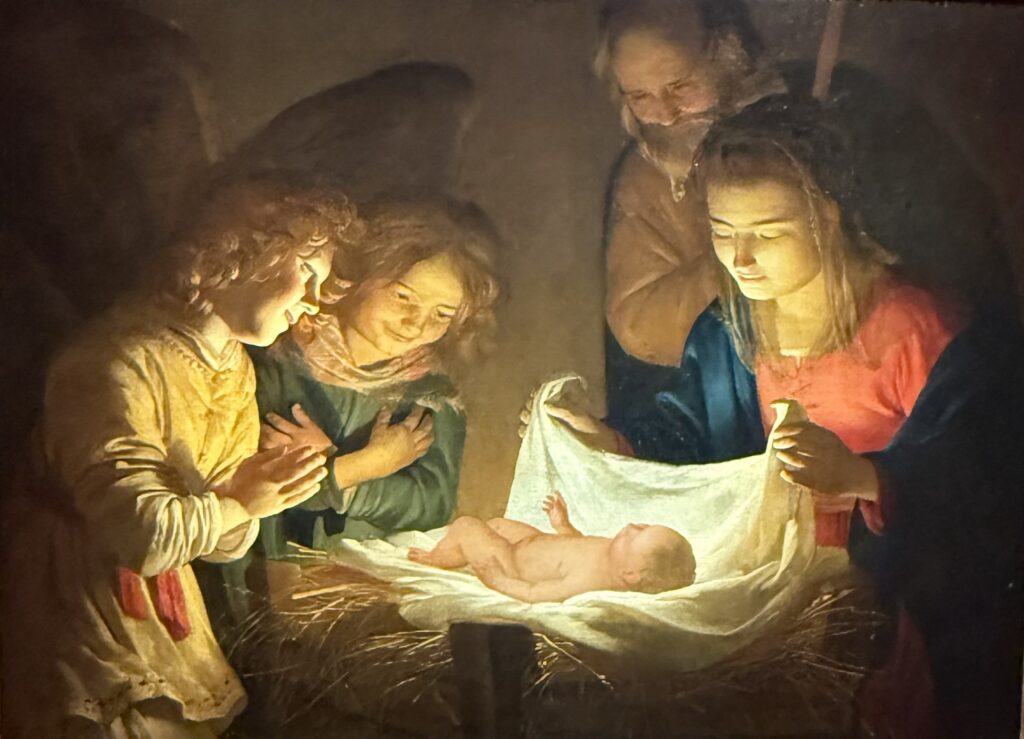
Our final Honthrost is a nativity scene with two angels adoring baby Jesus while Mary and Joseph over see. The light in the scene appears to be radiating from baby Jesus. This unusual lighting effect gives the painting its emotional power. The figures are not simply looking at the child; they appear to be receiving light from him. Honthorst turns the biblical idea of Christ as the “light of the world” into a visual experience. The result is intimate rather than grand: the viewer feels close to the family, almost as if witnessing the scene in the darkness of the stable.
After you are done with the Caravaggisti, lets move to the next room to find a painter that influence Caravaggio before actually admiring one of the finest Caravaggio’s in the world.
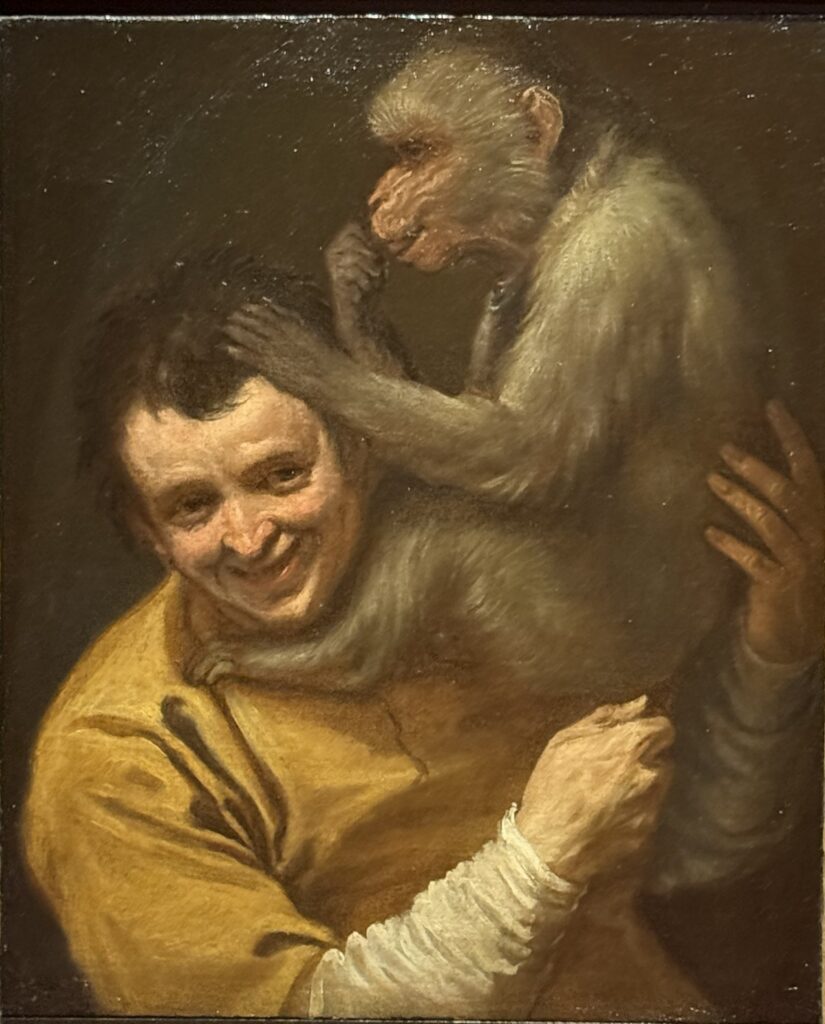
Carracci is from Bologna and was an extremely versatile and inventive painter, he truly set the stage for Caravaggio.
Carracci helped lead the shift from Mannerism to the Baroque by emphasizing direct observation. Here, the monkey is an active participant with carefully rendered fur and expression.
Anticipating Caravaggio, Carracci rejected artificial elegance for real presence. However, while Caravaggio favored tension, Carracci’s work offers a gentle, playful intimacy, capturing the newfound artistic value of everyday life.
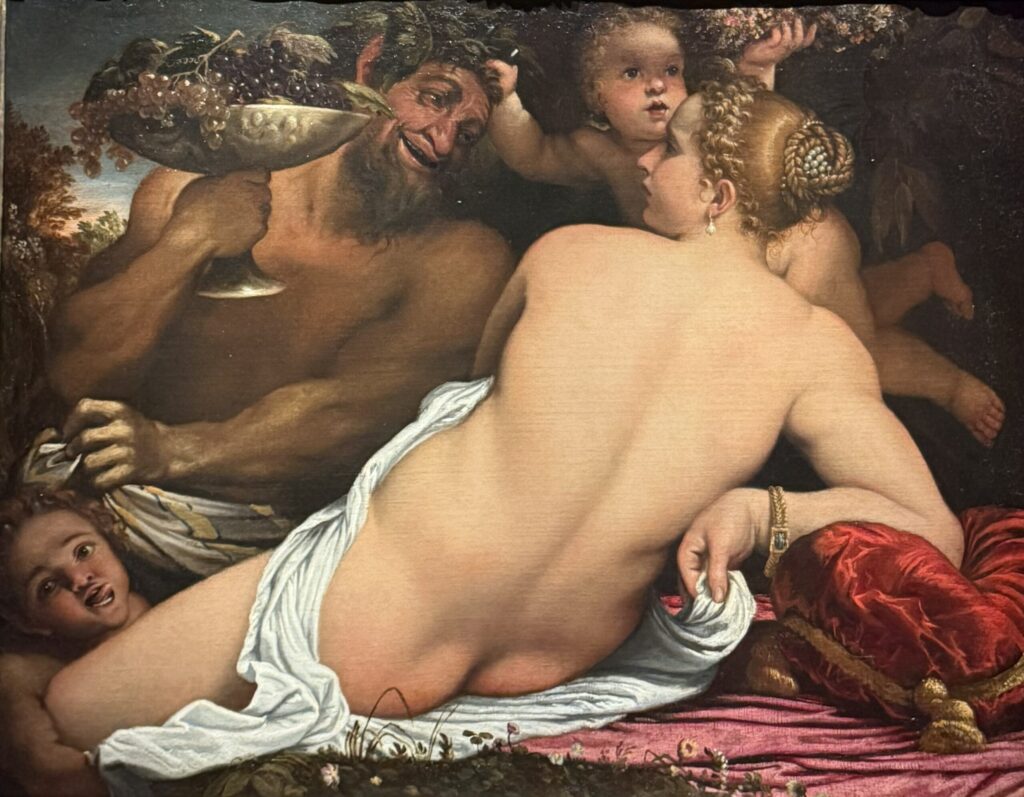
Annibale Carracci’s Venus with a Satyr and Two Cupids reveals an artist moving beyond late Mannerism toward the sensual color, naturalism, and emotional immediacy that would shape the Baroque. Its strongest influences include Correggio, Titian, Veronese, and the classical tradition, while the painting’s playful eroticism also reflects Carracci’s close artistic exchange with his brother Agostino.
It is thought that the cupid on the top right, who is tugging at the Satyrs horns is Anteros, who cautions restraint. The cupid on the bottom left, with his tongue out is Eros who is unable to hold withhold his passion for Venus.
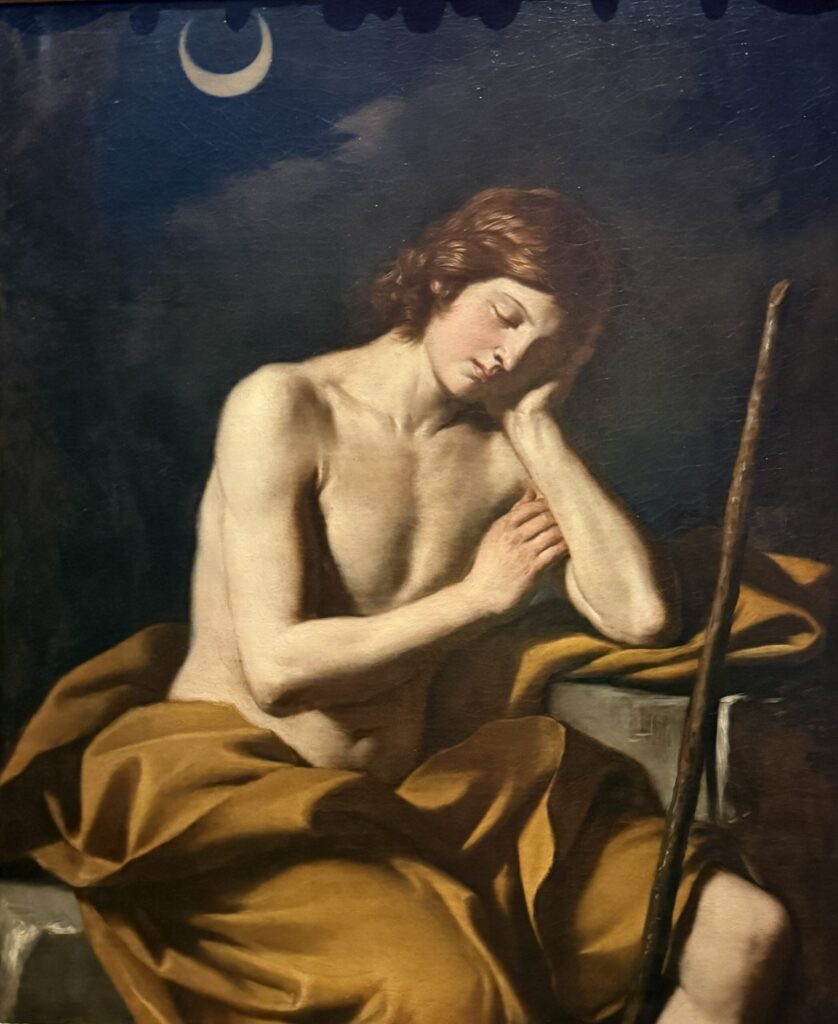
It would be easy to quickly glance at this Guercino and assume that it is a painting of a youthful St. John the Baptist. However, upon closer inspection you will see that the normal iconography is not there. This is actually a painting of the shepard Endymion.
In Greek mythology, Endymion was a beautiful shepherd loved by Selene, the goddess of the moon. She asked Zeus to grant him eternal sleep so that his youth and beauty would never fade. Guercino focuses on the moment of suspended time: Endymion sits in darkness, his head resting heavily on his hand, while the moon appears behind him.
The subject allowed Guercino to combine mythological sensuality with psychological stillness. Endymion’s body is youthful and idealized, but his pose is not triumphant. He appears vulnerable, withdrawn, and entirely unaware of the divine attention directed toward him. The painting’s emotional center is therefore not action but absence: the sleeping figure cannot see the goddess who loves him.
Now we move on to one the most beloved pieces in the entire Uffizi Galleries.
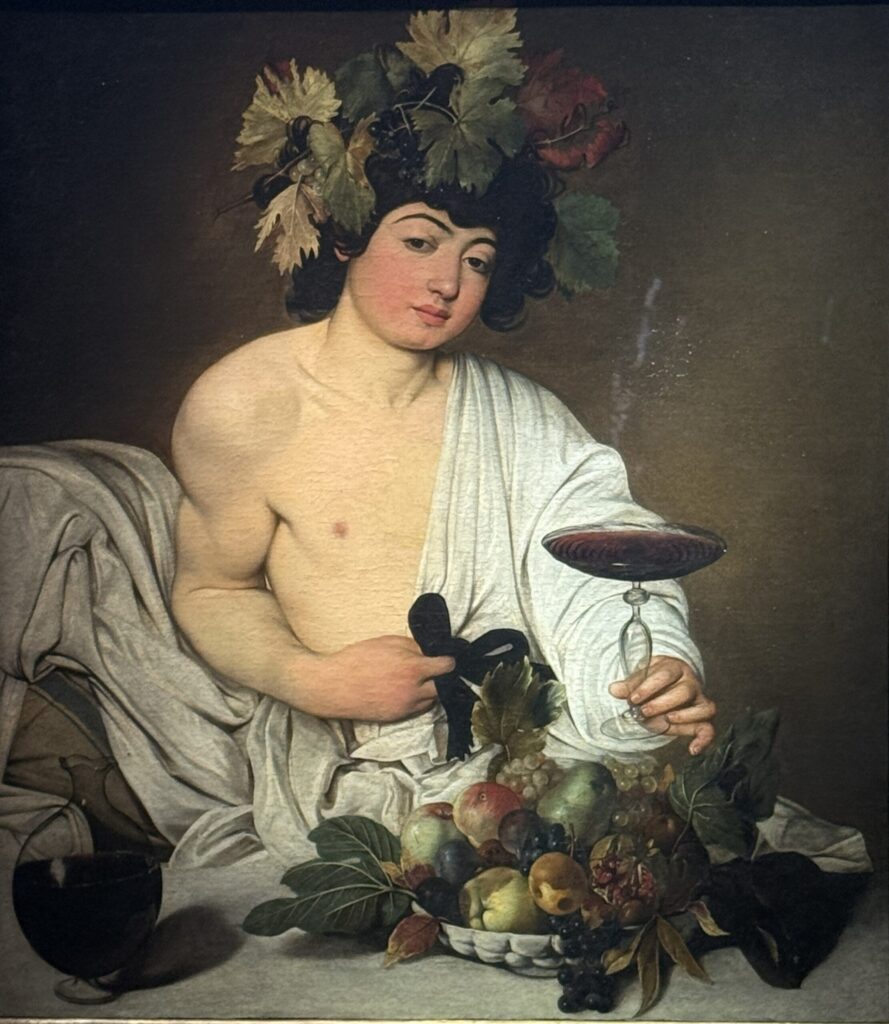
Caravaggio’s most radical decision is to present Bacchus not as an idealized deity but as a believable, slightly disheveled youth. His flushed face, loose clothing, and relaxed pose make him seem less like a distant mythological figure than a young man encountered at a Roman gathering. The painting’s intimacy is heightened by his direct gaze: Bacchus appears to look straight at us, turning the viewer into a participant in the scene.
The painting’s surface is full of sensual details; the shine of the wine, the texture of the fruit, the softness of the skin. However, these pleasures are not entirely secure. Some of the fruit appears bruised or beginning to decay. Such details may suggest a vanitas theme, reminding us that youth, beauty, and enjoyment are temporary.
The offered wine therefore has an ambiguous meaning. It may represent friendship, conviviality, and the freedom of the senses, but it may also be a temptation. Bacchus invites us to accept pleasure while quietly reminding us that pleasure can lead to excess. The Uffizi notes that critics have interpreted the wine and fruit as an invitation to moderation, sociability, and friendship, while also emphasizing the painting’s sensuality and references to Bacchic ritual.
After you are done with Bacchus, we move to our final room on this short Baroque tour.
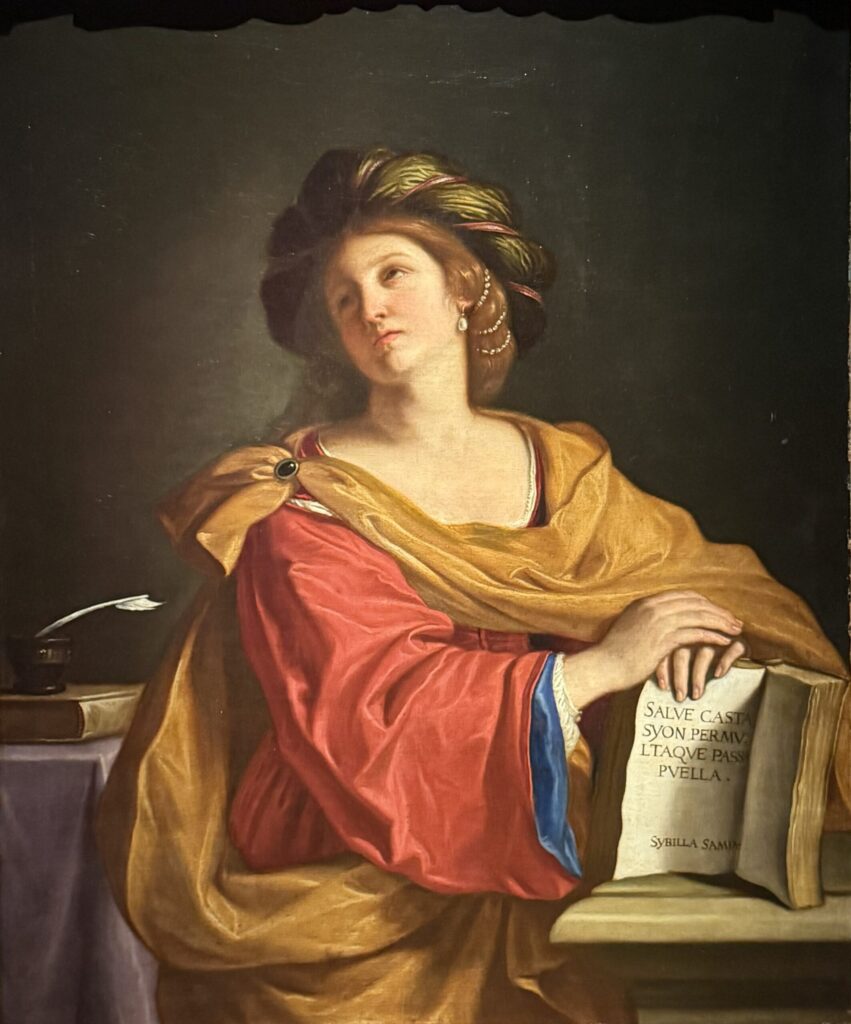
She is not shown as a distant goddess or a dramatic fortune-teller. Instead, she appears thoughtful, learned, and intensely human. Her identity is revealed by the title: she is the Sibyl associated with Samos, the Greek island in the eastern Aegean.
A sibyl was an ancient female prophet or oracle, believed to speak under divine inspiration. Classical and Christian traditions eventually identified several Sibyls by the places connected with them, including the Cumaean, Persian, Libyan, Erythraean, and Samian Sibyls. In Christian Europe, these pagan prophetesses became important because they were believed to have anticipated the coming of Christ, just as the Old Testament prophets had done.
Guercino’s Samian Sibyl is has a book opened to the page “Salve casta Sion per multaque passa puella”, meaning approximately, “Hail, chaste Sion, who has suffered much.” The inscription refers to the Virgin Mary and connects the Sibyl’s ancient prophecy with the Christian story of Christ’s birth.
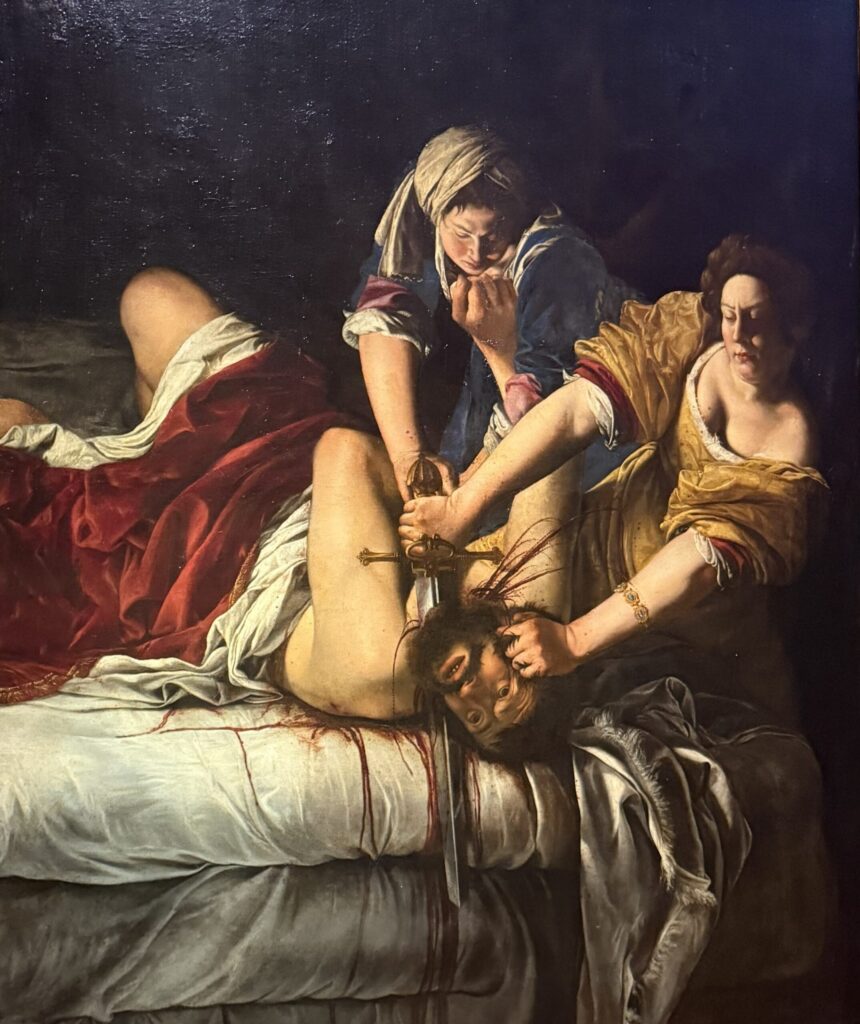
Here we see Artemisia’s take on the popular Judith and Holofernes story in the bible. She places the viewer extremely close to the bed. Judith and her maidservant Abra lean into Holofernes with their full bodily strength. Judith grips the sword and Holofernes’s hair, while Abra restrains him. Their rolled-up sleeves make the murder look like demanding physical work, not a symbolic gesture. The blood spurting across the white sheets and onto Judith’s clothing intensifies the realism. The Uffizi describes the scene as powerful and frightening, emphasizing Judith’s determination and the graphic force of the blow.
Artemesia presents the very physical struggle of the murder, showing the strength and determination of Judith. Compare this with the Rubens depiction we saw earlier. Rubens turns the story into a theatrical, sensual, and richly colored spectacle; whereas Artemesia’s is dark and gritty.
Our final Caravaggio is at the back of the room in 3-dimensional bliss.
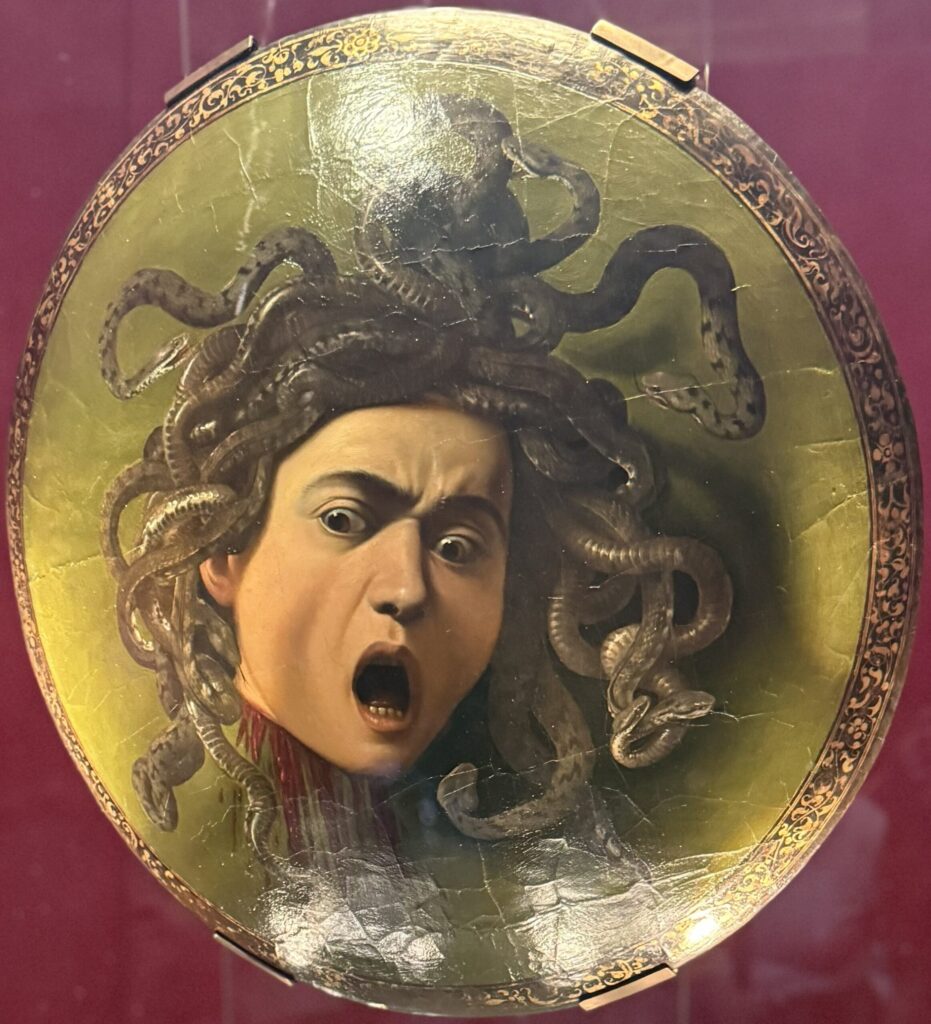
Caravaggio depicts Medusa’s severed head at death, screaming with terror as snakes writhe in her hair. Instead of a distant monster, she confronts the viewer directly, creating a visual trap that reverses the myth where looking at her turns people to stone.
Her intensely physical face features blood, an open mouth, and a distorted expression that feels uncomfortable. This stark realism reflects Caravaggio’s signature style of using dramatic lighting and ordinary bodies to make mythological subjects immediate.
Painted on a convex shield, the artwork recreates Perseus’s method of viewing Medusa through reflection. This curved surface slightly distorts the head, giving the painting a theatrical, sculptural presence where Medusa seems to project outward.
This concludes our short Baroque focused Uffizi Galleries itinerary. See below for some bonus non-Baroque works.
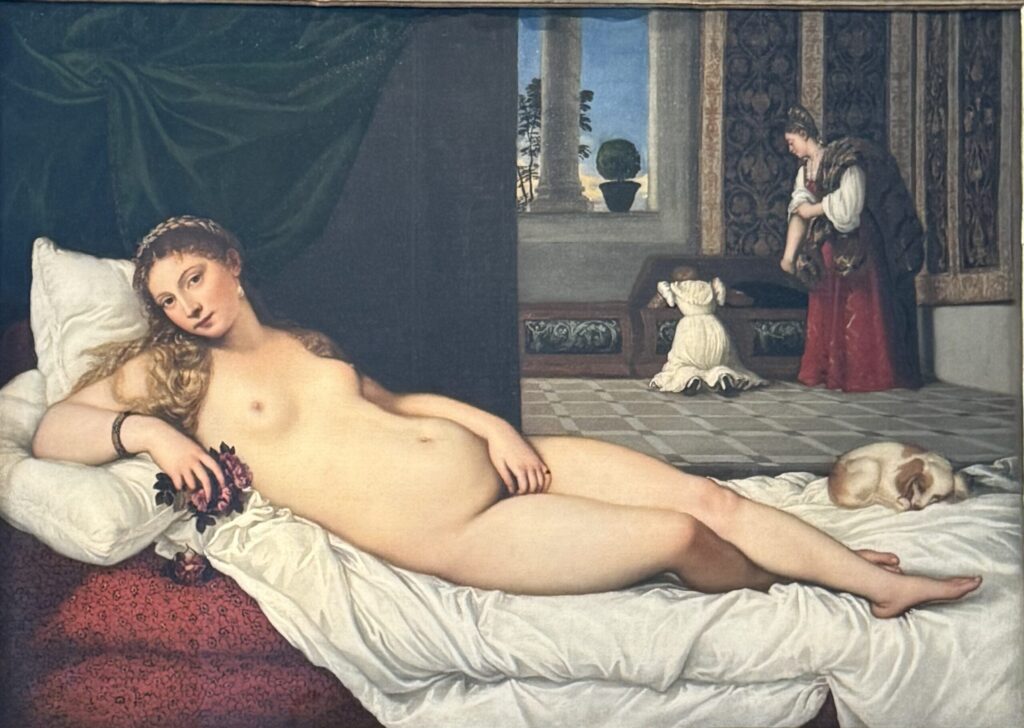
Titian’s Venus of Urbino hangs in room D23 on the first floor. Few Uffizi works engage visitors as directly. Reclining calmly, the confident young woman expects our gaze.
Titian turned the traditional nude into an intimate, psychological masterpiece. Brought indoors to a Venetian room, she is both goddess and human.
This combines erotic display with domestic symbols. The dog signifies fidelity, while flowers honor love and Venus. Wedding chests suggest a marital theme.
Historians debate her identity: bride, Venus, courtesan, or ideal beauty. Background attendants imply marriage, yet remain inconclusive.
This uncertainty enhances the painting’s allure, blending love, sexuality, marriage, wealth, and status.
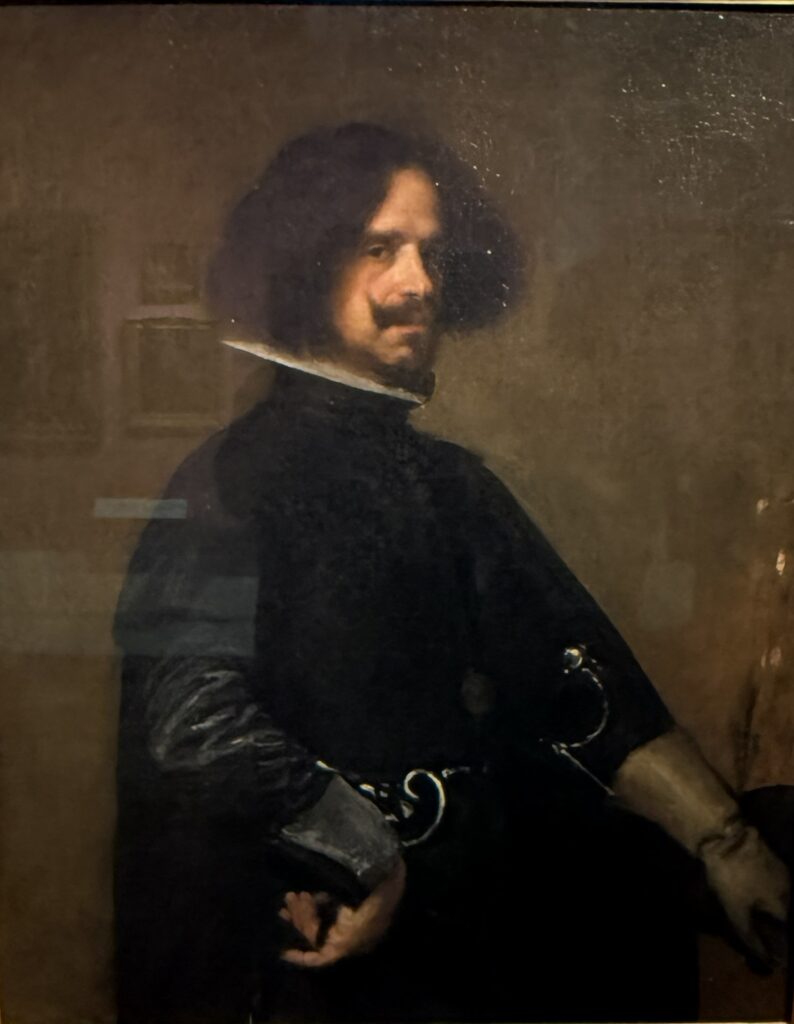
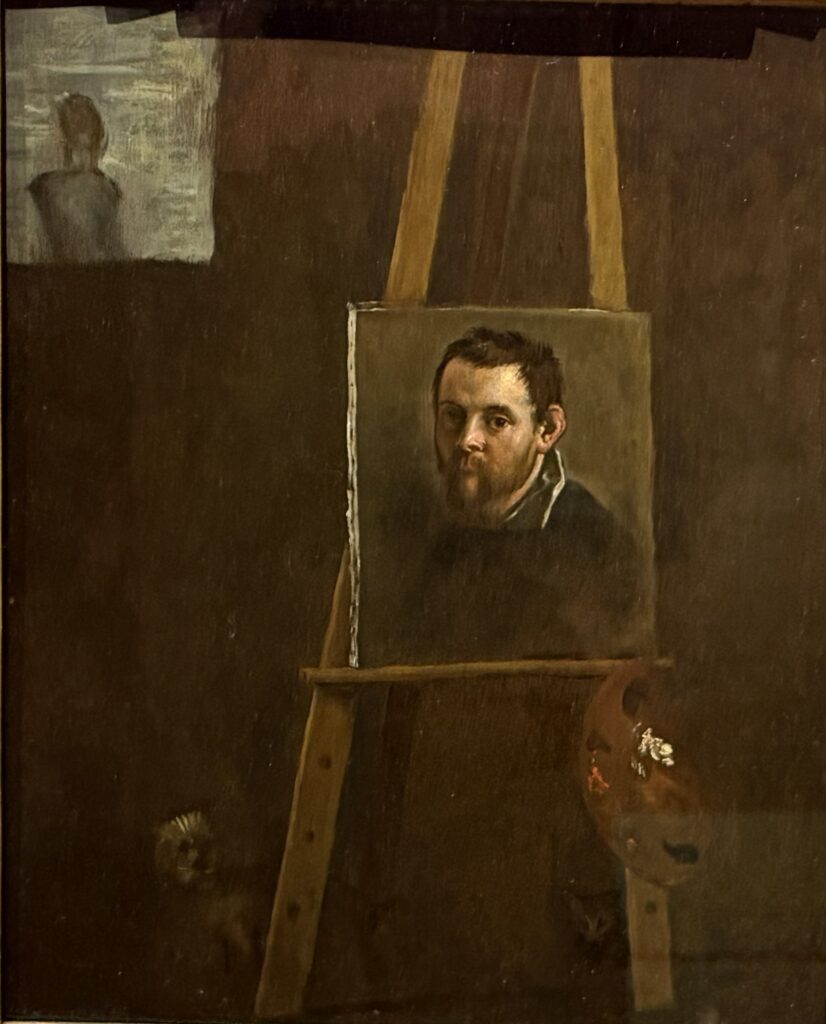
In the C section of the gallery, also on the first floor (second floor in US terms) you will find many sef-portraits. These two are fantastic Baroque representations. Annibale Carracci’s and Diego Velázquez’s self-portraits at the Uffizi present two very different ideas of the artist: Carracci appears as a private, thoughtful observer, while Velázquez projects the controlled presence of a court painter. Seen together, they show how self-portraiture could express both personal character and professional identity.
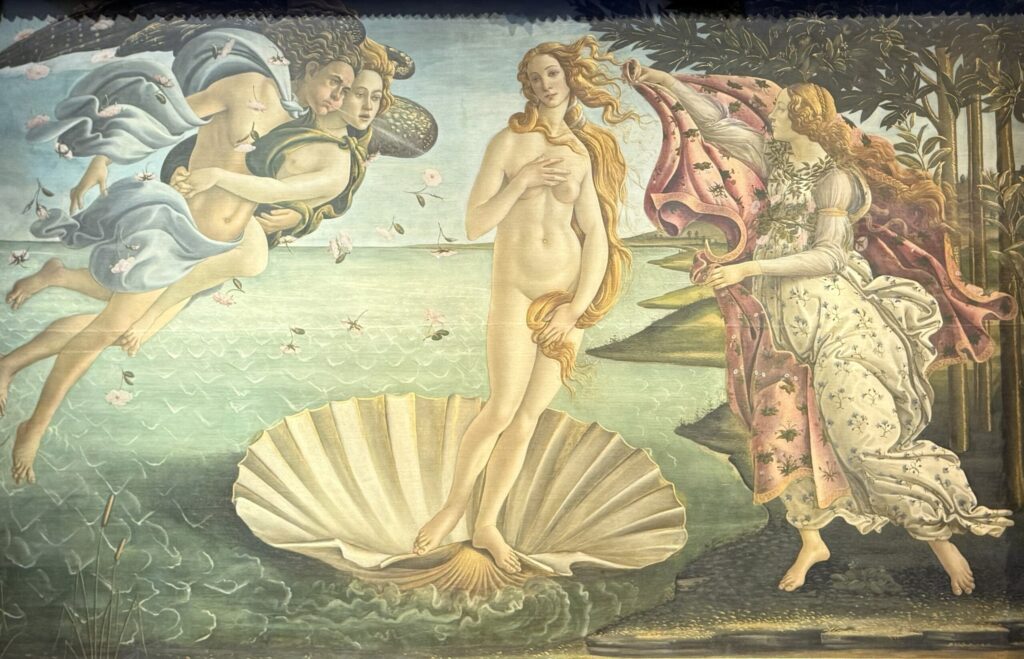
If you make your way up to the 2nd floor (3rd floor in US terms), just look for the crowds of people to find the next bonus work. Few paintings are as instantly recognizable as Sandro Botticelli’s The Birth of Venus. Venus stands at the center of the composition on a giant scallop shell, her long golden hair flowing around her body. To the left, the wind god Zephyr blows her toward the shore, while a female companion; possibly Aura (the personification of a breeze) moves with him. On the right, a young woman reaches forward with a flower-covered cloak, ready to cover Venus as she arrives.
The scene is not quite the moment of Venus’s birth. Instead, it shows the goddess arriving on land, having emerged from the sea foam. The distinction matters because the painting is less interested in a dramatic act of creation than in the appearance of beauty in the world.
Leave a Reply