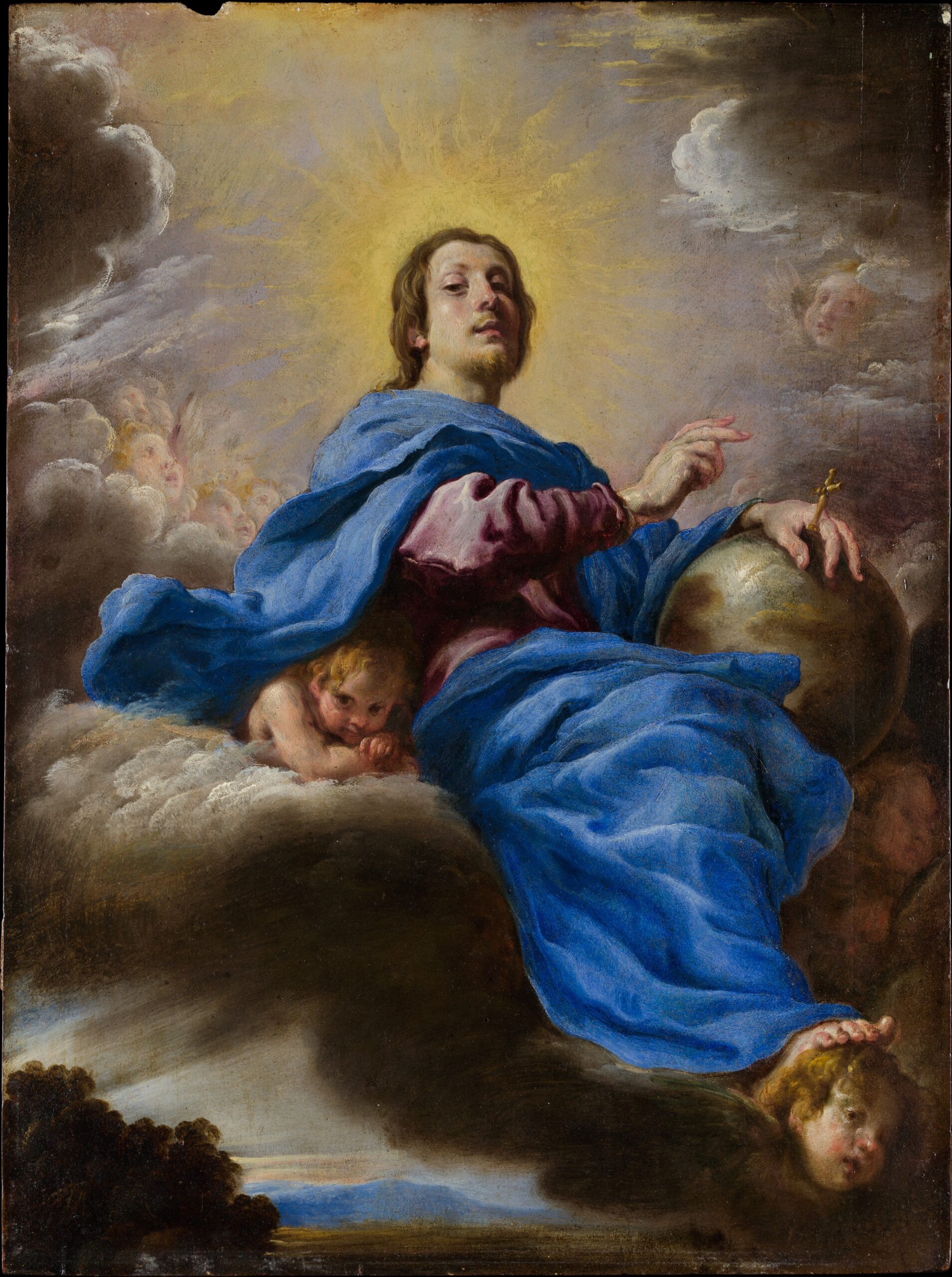

Pope Pius XI created the feast of Christ the King in 1925, in response to growing secularism after the First World War. The feast holds that Christ’s authority reaches every nation and every person. Today the Church keeps it at the end of the liturgical year, just before Advent. The painter Domenico Fetti made a Salvator Mundi.
Pius XI instituted the feast in the encyclical Quas Primas, issued in 1925. He wrote it as the Church marked the sixteen hundredth anniversary of the Council of Nicaea, and he was troubled by the rejection of Christ’s authority in public and political life. The encyclical teaches that Christ’s kingship is real and not only a figure of speech, and that his authority extends over all people. It also expresses the hope that if the kingdom of Christ received all nations under its sway, the peace that the King of Peace came to bring on earth would follow.
Wikipedia says that in 1969 Pope Paul VI renamed the feast Our Lord Jesus Christ, King of the Universe, gave it the rank of solemnity, and moved it to the last Sunday of the liturgical year. The reason given was that this makes the eschatological importance of the Sunday clearer, meaning its link to the end of time.
No Baroque painting shows the feast itself, so this picture is paired by theme. Salvator Mundi is Latin for Savior of the World. Domenico Fetti, an Italian Baroque painter, worked in Mantua from 1613 to 1622 and then moved to Venice, where he died in 1623, according to Wikipedia. The Metropolitan Museum of Art in New York dates its Salvator Mundi to about 1622 and 1623, and records it as oil on wood, about 60 by 44 centimeters, a gift of Dianne Modestini in 2007.
- Feast day: November 22, 2026
- Celebrated as: Solemnity
- Painting: Salvator Mundi (about 1622 to 1623)
- Artist: Domenico Fetti
- Collection: The Metropolitan Museum of Art, New York
Leave a Reply