Overview
The Metropolitan Museum of Art (The Met) in New York is one of the world’s largest and most comprehensive art museums, containing over two million works that span 5,000 years of global artistic history. Founded in 1870 and located along Fifth Avenue beside Central Park, it showcases everything from ancient Egyptian monuments to modern masterworks, making it a cornerstone of New York’s cultural landscape.
The Met’s Baroque collection reflects the full geographic breadth of 17th‑century artistic innovation, featuring works from all the major centers of Baroque production. Alongside masterpieces by Caravaggio, whose revolutionary naturalism helped define the era, the collection represents the Caravaggisti who carried his dramatic tenebrism across Europe; artists from Northern Italy, where dynamic composition and emotional intensity flourished; the French Baroque, shaped by classical balance and intellectual rigor; the Spanish Baroque, known for its spiritual depth and stark realism; and the vibrant Dutch Baroque, celebrated for its mastery of light and genre scenes. Together, these works highlight the diversity and expressive power that made the Baroque one of the most influential movements in European art.
Before you go
The Met’s website has information on hours and tickets. The 5th avenue location is the home of their Baroque collection. Generally, they are open at 10am and close at 5pm during the week (closed on Wednesdays). On the weekend they are open from 10am-9pm. Be sure to check the Closed Galleries section of their website to ensure the European Paintings 1250-1800 section is open. The rooms we visit in this itinerary are : 620,622,624,635,637. We always recommend buying tickets in advance and arriving at opening for the best museum experience.
The Entrance
When you arrive, you will notice two lines that are streaming off to the sides of the building. You need to get into one of the lines, they are security lines and everyone has to go through security, regardless of your ticket status. Once you get through security you can grab a physical map if you’d like and head toward the massive staircase in the center of the lobby, show your tickets and head up to the top of the stairs. At the top of the stairs walk straight into room 600 then veer slightly left and continue in room 601 and veer slightly left again and continue into room 635 where you will see our first piece in the middle of the room.
Christ on the Cross
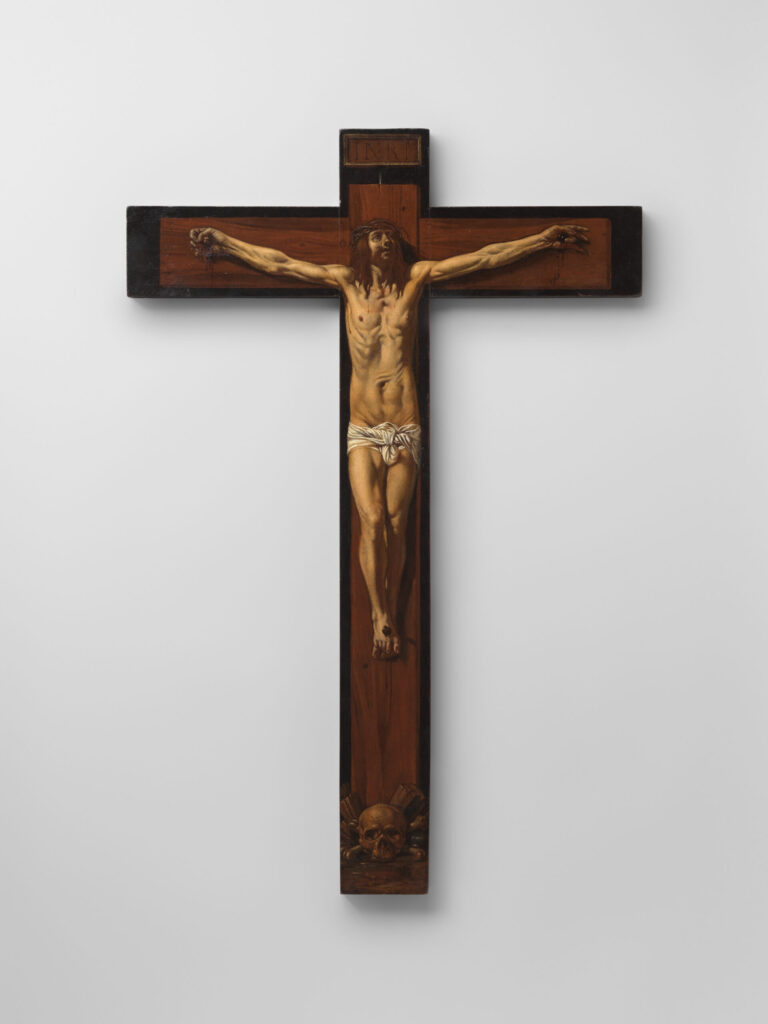
Christ on the Cross (c.1615) by Cecco del Caravaggio (Francesco Buoneri) What Cecco accomplished with this cross-shaped piece of wood is truly remarkable. The excruciating detail in Christ’s face and body; his agony, his struggle to breathe, his upward gaze toward God feels even more intense and visceral because it’s rendered on an actual wooden cross, not simply painted on canvas. It brings the suffering to life in a hauntingly tangible way. The details on the back of the cross continue this intense naturalism as we see the blood running through the nails in his hands as well as part of his body that is off the side of the cross.
This is only the second work by Cecco del Caravaggio that the BAAC has witnessed first hand, the other is located at the Art Institute of Chicago and both are truly exceptional.
Walk through room 636 and into 637 where we will find a remarkable piece by one of just a few women Baroque artists. After entering room 637 turn 180 degrees and look to the right of the doorway where you just entered to find our next piece.
Merry Company
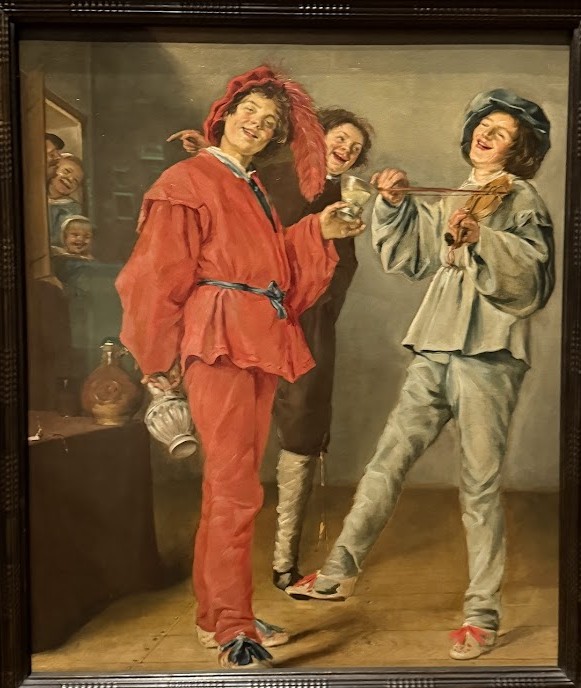
Merry Company (c.1629) Judith Leyster. While we’re currently focusing on Baroque art from Italy, Spain, and France, we always make a point to highlight the Dutch Golden Age painter Judith Leyster whenever we come across her work. She was one of the few well-known female painters of the Baroque period, and only a few paintings have been definitively attributed to her. For many years several of her works were mistakenly credited to Frans Hals, a testament to both her talent and the gender biases of the time.
In Merry Company, we see three full-length figures enjoying a lively gathering, while a few onlookers smile from the doorway, sharing in the revelry. Perhaps the scene depicts three brothers joyfully reuniting after a long separation, as their parents and younger sister watch fondly from a distance. The painting captures a moment of warmth, connection, and celebration, hallmarks of Leyster’s lively and humanistic style.
As you turn to leave the room, take a look at the painting to the right of the door, a genre piece by the BaroqueFather himself, Annibale Caracci.
Two Children Teasing a Cat
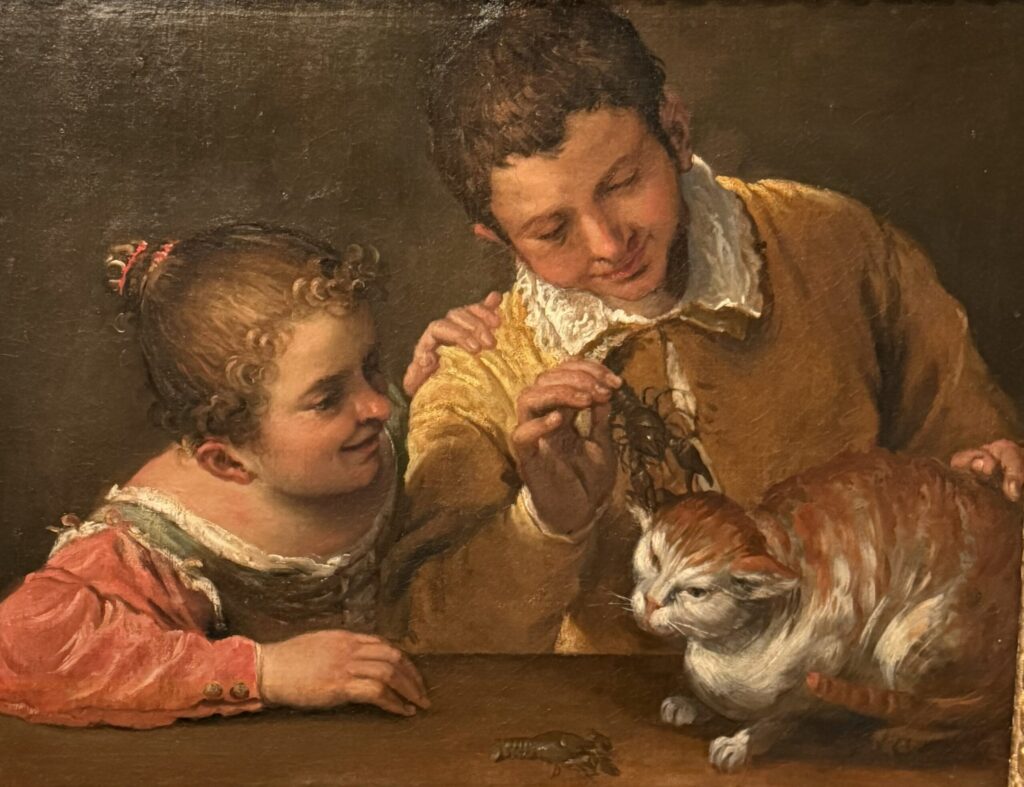
Two Children Teasing a Cat (c.1587) Annibale Caracci. In this lively genre scene, Annibale Carracci captures a mischievous moment as two children play with a clearly irritated cat. A crayfish clamps onto the cat’s ear, adding to its distress, and it seems only a matter of time before the girl’s hand is met with claws. Like many scenes of everyday life from this period, the painting likely carries a moral message. As the Met’s caption suggests, it might be a visual warning to “let sleeping dogs lie” or perhaps, more pointedly, “if you mess with the bull, you get the horns.”
Walk into the next room, 620, where we find many absolutely breathtaking Italian Baorque paintings from both the North and South of Italy.
The Coronation of the Virgin
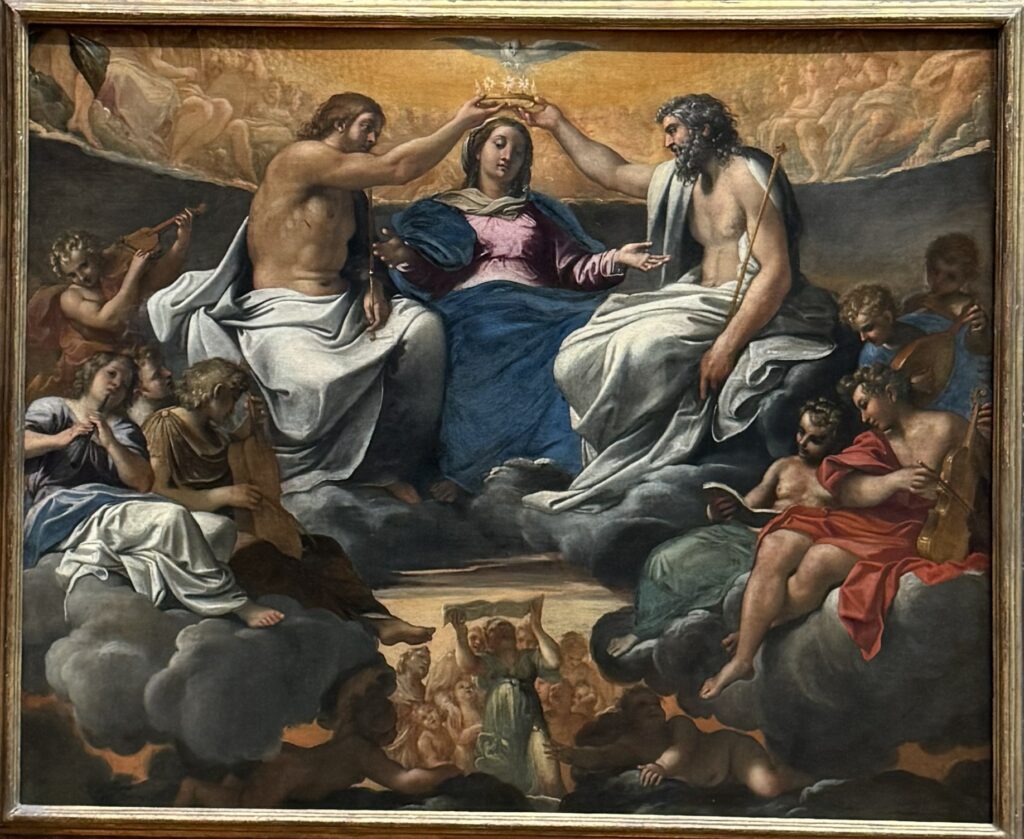
The Coronation of the Virgin (c.1595) Annibale Carracci. In this painting, the Virgin is depicted being crowned by the Holy Trinity. The Holy Spirit appears above her in the form of a dove, while God the Father and Christ the Son flank her on either side. Carracci’s composition reveals his deep admiration for Renaissance art: the vibrant, harmonious colors recall the work of Titian, while the balanced arrangement and graceful positioning of the figures reflect the influence of Raphael.
Immediately to the left is another Caracci masterpiece.
St. John the Baptist Bearing Witness
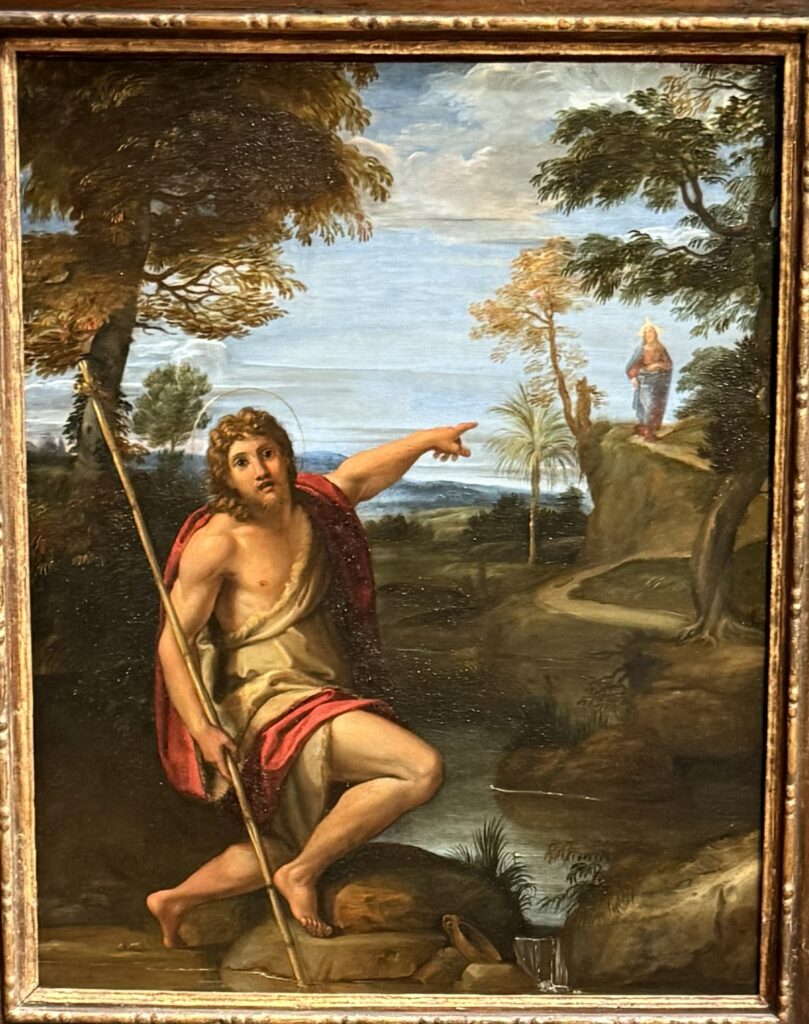
Saint John the Baptist Bearing Witness (c.1600) Annibale Caracci. Here we see John the Baptist wearing his usual animal skin clothing and carrying a staff with the cross on top. The saint has turned toward us to direct our attention to a figure in the distance. At first glance, based on the clothing, pose and the light obscuring the face you might mistakenly think that we are looking at Mary; however, upon closer inspection see that we are witnessing Jesus making his way down the path to be baptized by John.
John the Baptist looks a little wooden, especially his face, the Met gallery label indicates that Annibale had recently finished studying Roman sculpture prior to painting this piece.
Move to the right, past the doorway to find arguably Caravaggio’s most popular painting that is housed in North America.
The Musicians
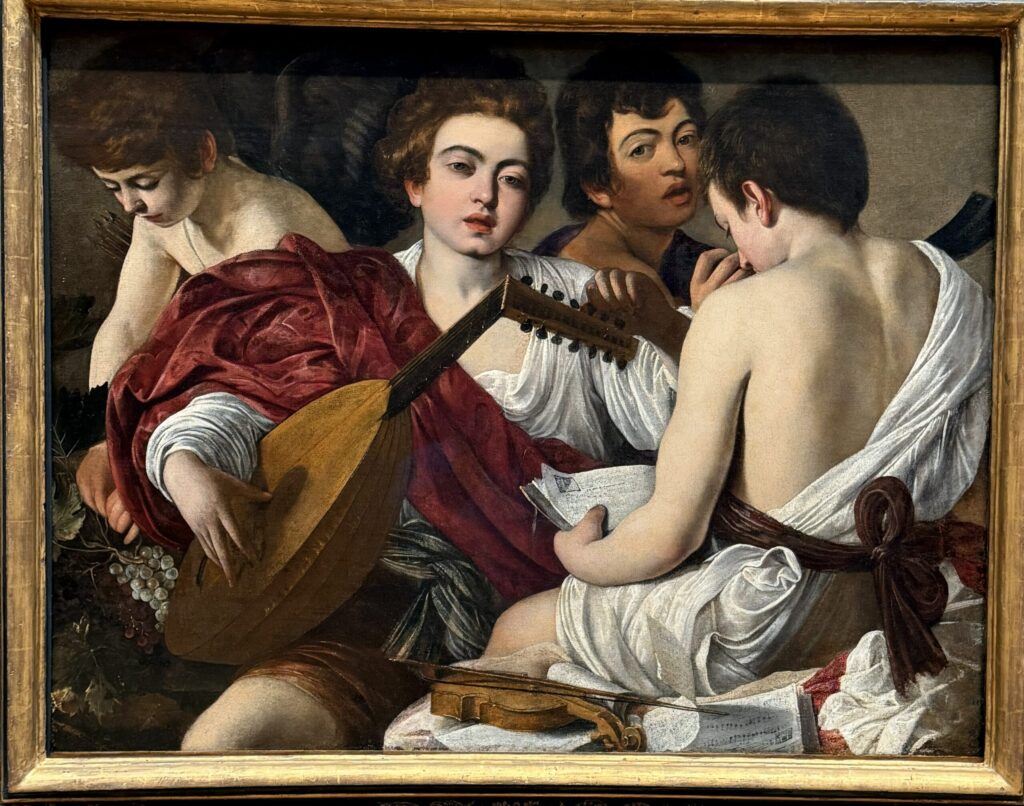
The Musicians (c.1597) Caravaggio. On the surface, we seem to be interrupting three musicians in a cramped room, warming up before a performance. Beside them, a young Cupid divides a bunch of grapes, perhaps to share as a pre-concert snack.
Painted for Cardinal Del Monte, a devoted patron and lover of the arts, the scene appears to celebrate music, youth, and pleasure. Yet Del Monte was also a Cardinal, and his commissions often carried moral lessons beneath their beauty.
Recent research has revealed something remarkable. The musical content of this painting, long obscured by damage to the canvas, has finally been identified. The musicians are preparing to play a setting of the second part of Iacopo Sannazaro’s sonnet “Icarus fell here, these waves do know it.”
This choice of music warns of the dangers of excess, reminding us that even as art and passion lift us toward the divine, unbridled desire can lead to a fall.
To the right of the Caravaggio is our next piece from a popular Roman artist.
The Vocation of Saint Aloysius Gonzaga
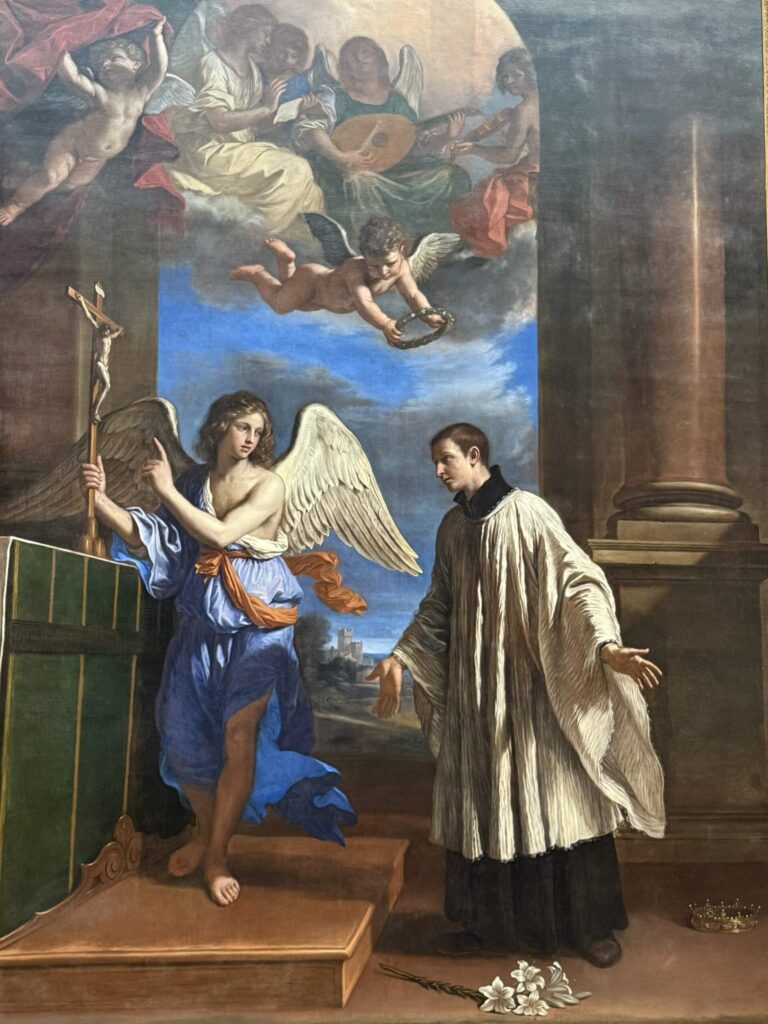
The Vocation of Saint Aloysius Gonzaga (c.1650) Guercino. This beautiful painting captures young Aloysius Gonzaga turned away from wealth and privilege to follow his calling to serve God. Guercino’s use of light and emotion brings to life the saint’s purity and devotion. You can see the angel crowning Aloysius with a wreath crown while his metal crown representing his wealth and status lays discarded on the ground.
Fun fact: Gonzaga University in Spokane, Washington, is named after Saint Aloysius himself—carrying on his legacy of faith, learning, and service.
As we keep moving to the right, past another doorway, to find another absolute masterpiece on the tour.
The Death of Cleopatra
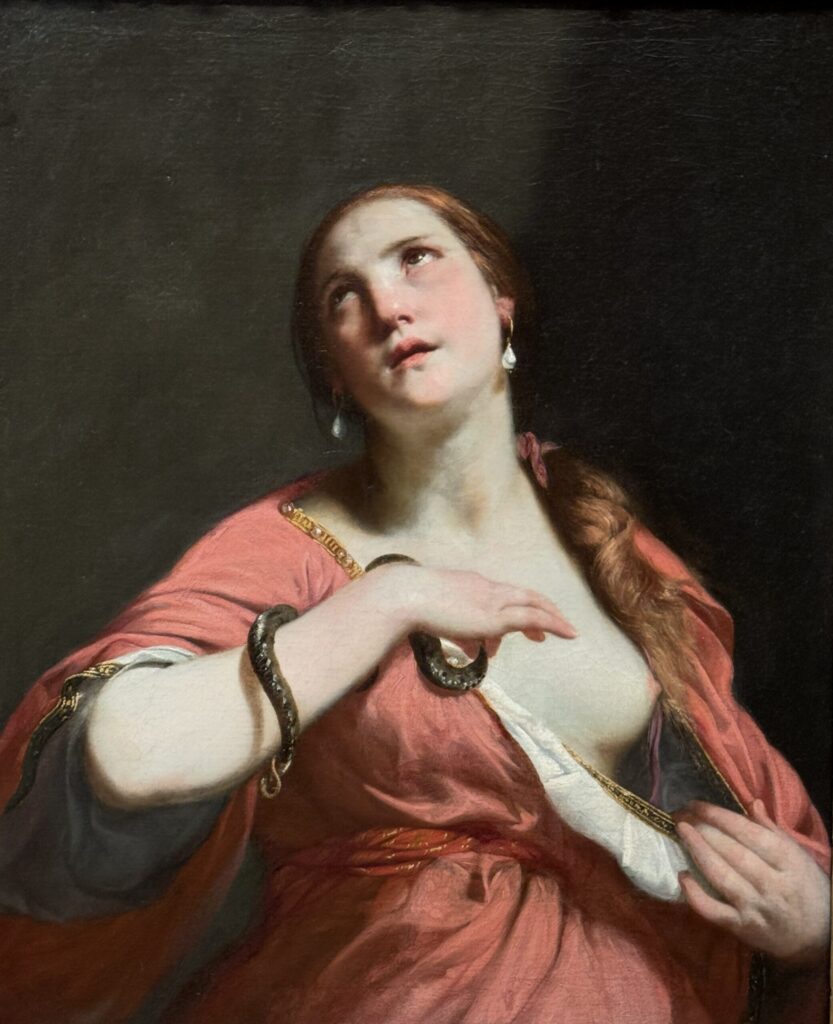
Death of Cleopatra (c.1645) Guido Cagnacci. This theatrical and erotic depiction of Cleopatra’s suicide is on brand for the Northern Italian painter. It is easy to envision this painting taking place on a stage where the heroine is so distraught from the defeat of Mark Antony that she feels her only course of action is to take her own life by letting a viper bite her breast.
Cagnacci was an admirer of the Northern Italian Baroque greats like Caracci, Reni and Guercino. However, Cagnacci chose to embrace the Baroque extremes, especially eroticism and theatricality. He is known to have lived an eccentric life; he never married but was constantly in the company of women, many whom dressed as men in order to avoid public condemnation.
Continue to the right to find a fantastic painting by Reni.
Immaculate Conception
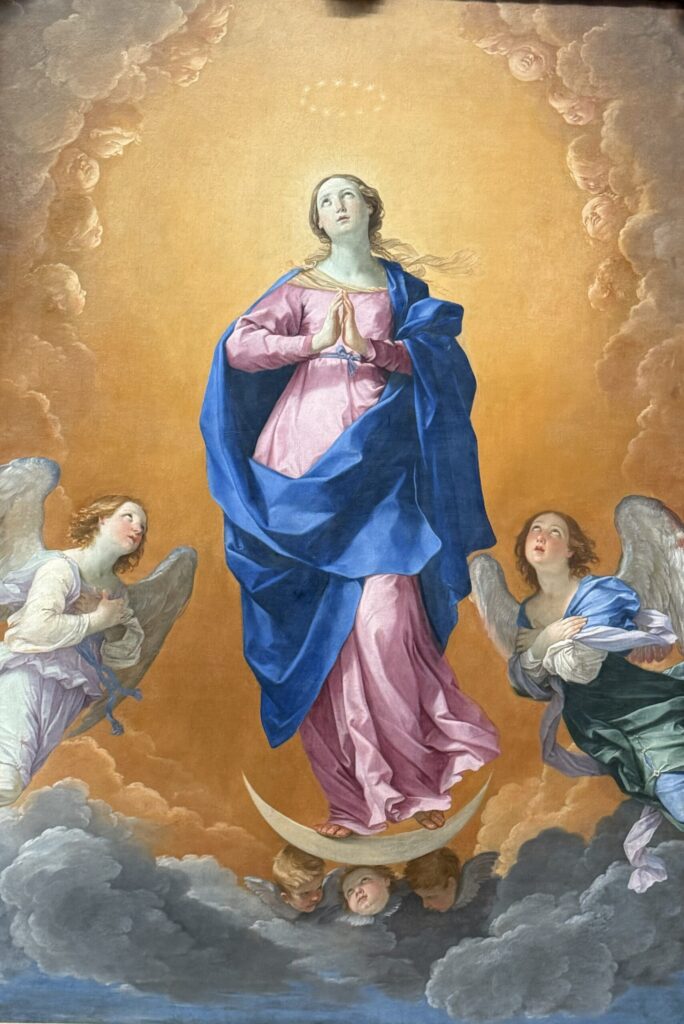
“Immaculate Conception (1627) Guido Reni. The gallery label tells us that the Spanish Ambassador in Rome commissioned Reni to paint this for the Infanta of Spain (Infanta refers to the daughter of the king). Eventually the painting was hung in the cathedral of Seville and was extremely influential to Spanish painters, especially Murillo. We highlighted one of Murillo’s Immaculate Conception paintings at the @clevelandmuseumofart in an earlier post.
At this point, turn around and head back to the doorway where you entered the 620 gallery to find our next Caravaggio.
The Denial of Saint Peter
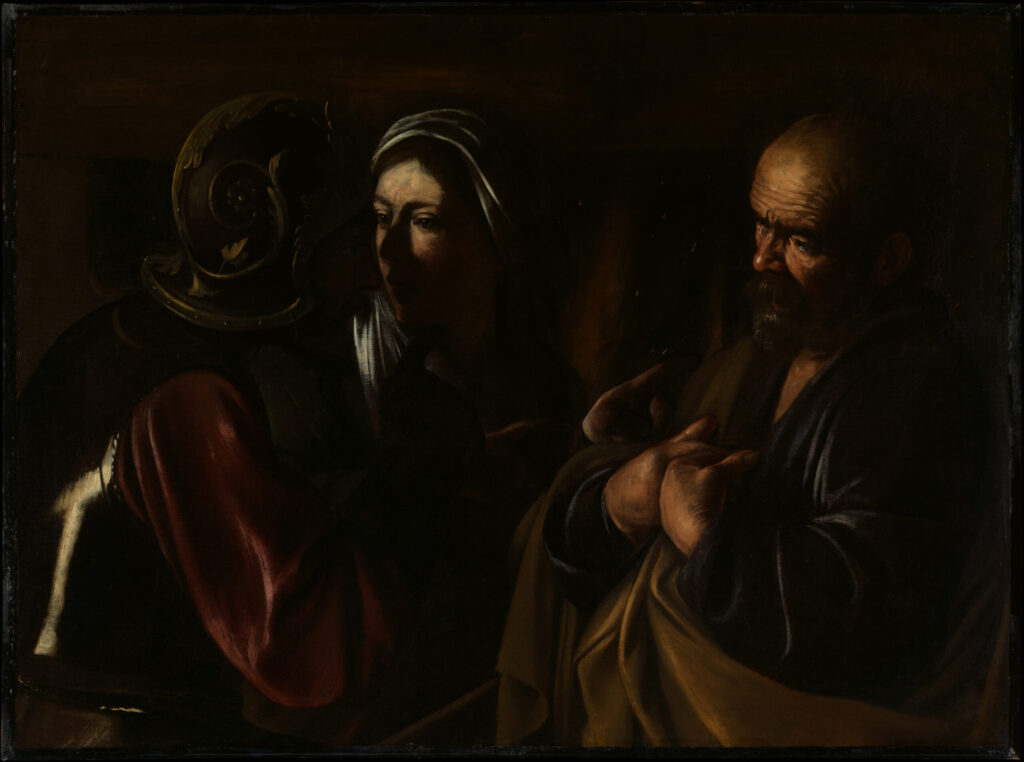
The Denial of Saint Peter (c.1610) Caravaggio. The Met is unique in that it is one of the few places in the world you can see an early Caravaggio and compare to it one of his last paintings. I’m not sure anyone who hasn’t studied Caravaggio in depth would recognize that the Musicians piece and this piece were painted by the same hand.
Notice how the solider is wearing a 16th century helmet and armor, this is Caravaggio’s way of showing us that he is painting a reenactment of the Bible story. Caravaggio insisted on only painting what is in front of him.
The Dormition of the Virgin
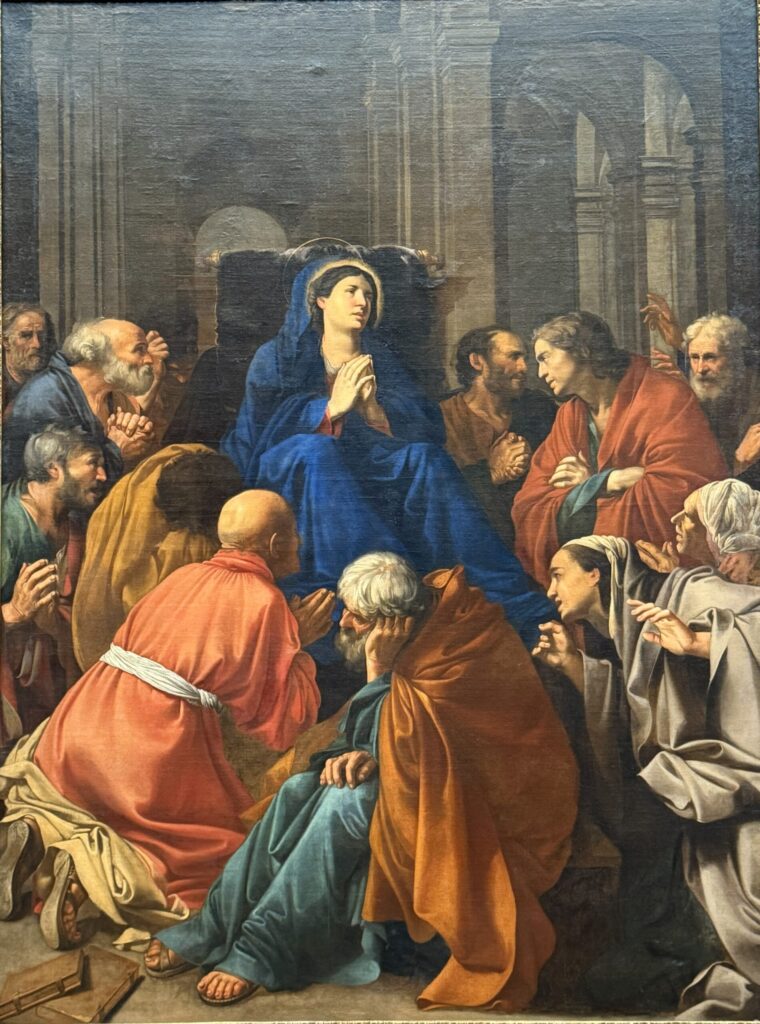
Dormition of the Virgin (c1612) Carlo Saraceni. After the Carmelites rejected Caravaggio’s intensely realistic take on the Dormition of the Virgin, Saraceni was commissioned to create a new version. His interpretation draws on Northern Italian influences, with a Renaissance-inspired color palette and carefully arranged figures. Yet the work remains grounded in naturalism and in its original form, the Virgin’s eyes were closed and her head gently slumped. The Carmelites, however, initially rejected Saraceni’s painting as well. He repainted the Virgin’s face, opening her eyes and directing her gaze toward heaven, but this revision was again refused. Ultimately, Saraceni created an entirely new canvas, which still hangs in the Carmelite church in Rome today.
Continuing to the left, you will find our final Caravaggio at the Met.
The Holy Family with St. John the Baptist
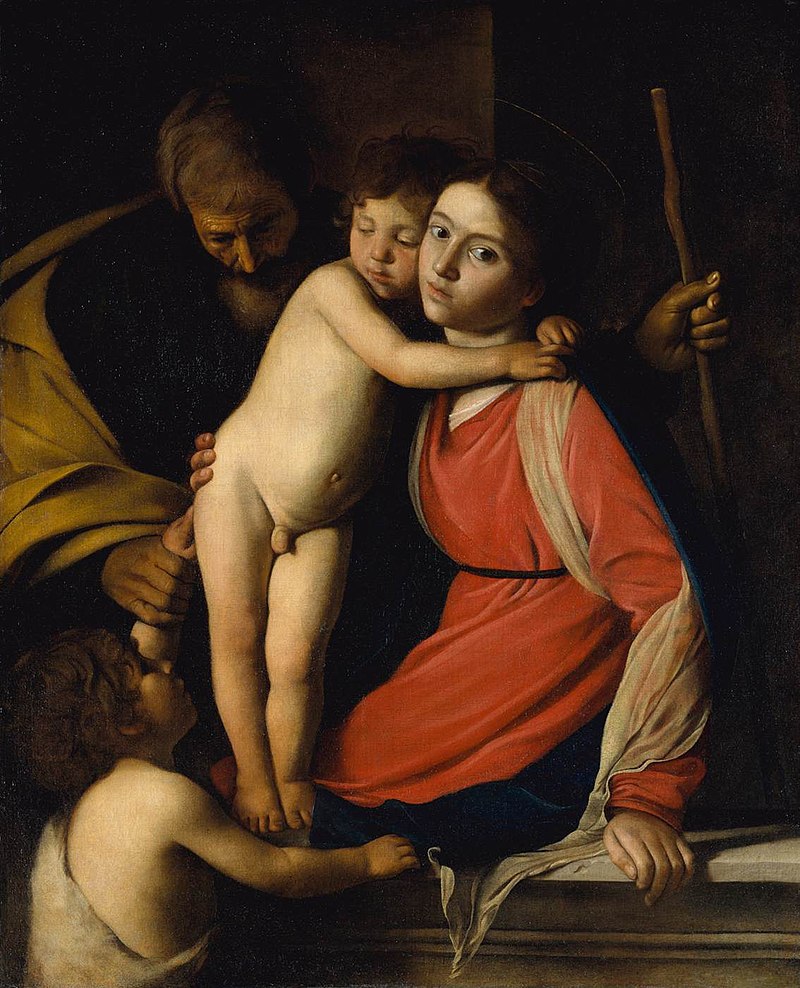
The Holy Family with the Infant St. John the Baptist (c.1600) Caravaggio. The attribution to Caravaggio is not universally agreed upon by Caravaggio scholars. However, The Met attributes it to Caravaggio and I’m not in a position to argue. It is disappointing that there is very little written about the piece on the Met’s website other than the thought that the painting was shipped to France soon after completion and that is why it is not mentioned by Caravaggio’s early biographers.
In any case, it is a beautiful painting with a very young Virgin Mary looking at us with the weight of the world on her shoulders. Baby Jesus’ posture shows his deep love for his mother while old man Joseph is protectively surrounding them both. It is also not universally accepted that Baby John the Baptist looks to be reaching for Jesus and Joseph is moving his hand away so that Jesus doesn’t fall, but I think that is what is happening.
Continuing to the left, we find a very interesting painting from Preti.
Pilate Washing His Hands
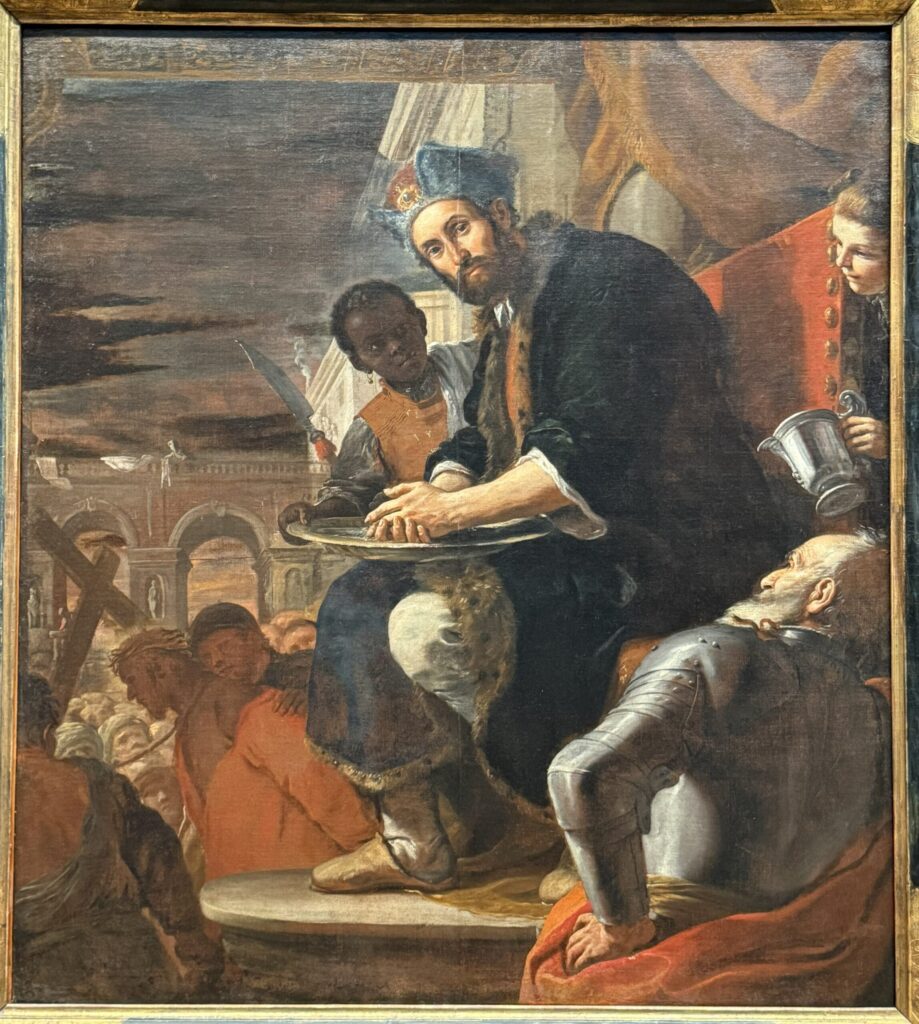
Pilate Washing his Hands (1643) Mattia Preti. Here we encounter Pilate, who is looking directly at us, washing his hands as Jesus is being led away in the background. Pilate knows Jesus is innocent and he attempted to get the crowd to release Jesus, but they did not. He is washing is hands to show us that he feels no responsibility for Jesus’ death.
This painting is remarkable for many reasons, including the expression of Pilate towards us, the fact that Jesus is in the background of the painting (how often does that happen?) and Preti’s inclusion of both an African boy and a 17th century armored solider.
The armored solider calls to mind Caravaggio’s “Crucifixion of St. Andrew” which features a similarly posed 17th century armored solider.
Exit the 620 gallery through the door at the end of the room and walk through room 621 and veer slightly left to enter room 623 and turn left to enter room 624 where we will find the French Baroque pieces of interest. Start on the left side of the room with the piece encased in glass.
A Peasant Family
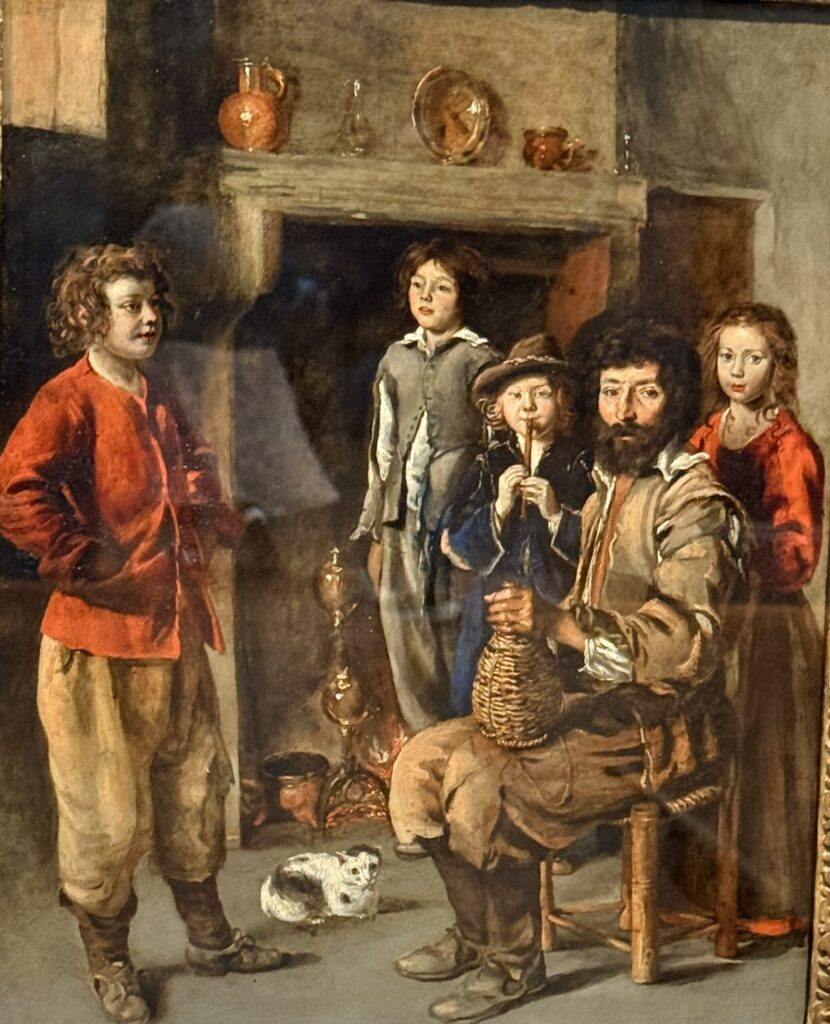
A Peasant Family (c.1640) Antione LeNain. This is an interesting piece in the LeNain oeuvre as it shows a posed family indoors wearing what I’ll call upper-class peasant wear. They have on leather shoes and colorful jackets, and look a little better fed than the typical LeNain peasant painting.
On the wall behind the LeNain painting you will find another peasant painting.
The Baker’s Cart
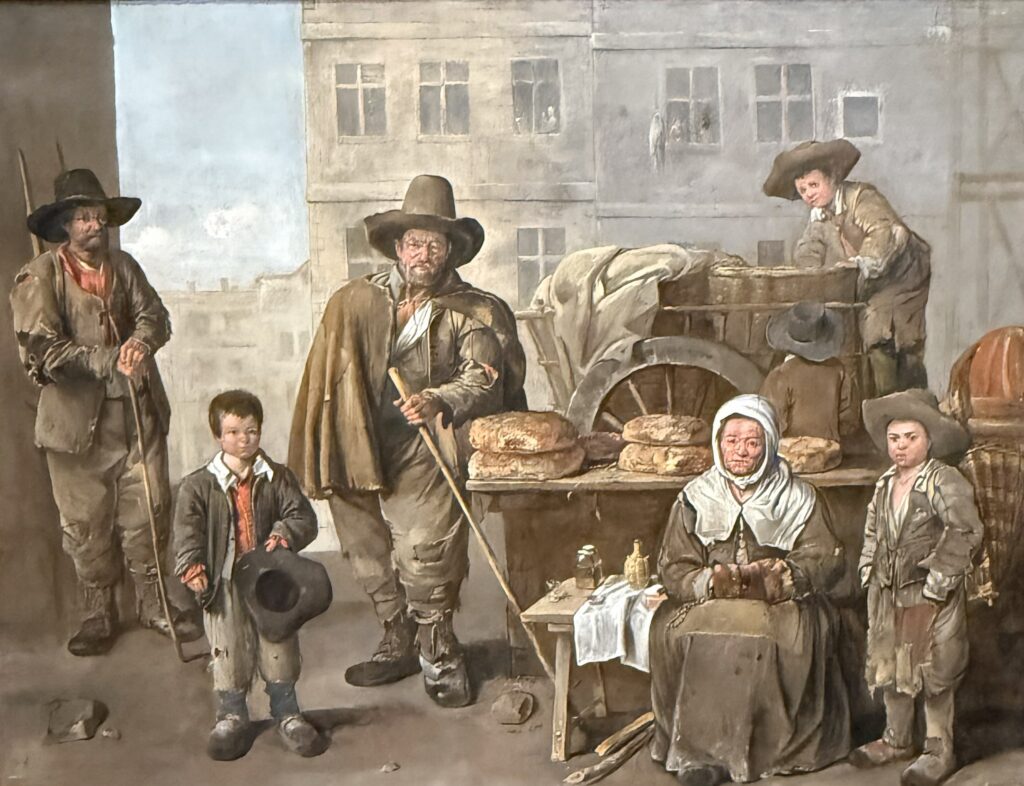
The Baker’s Cart (1656) Jean Michelin. At first glance, I assumed this was another LeNain peasant painting. I was surprised to see that it was Jean Michelin, an artist that I have not encountered yet. The gallery card says that Michelin liked to pose peasants with dignity similarly to the LeNain brothers, but he did so in urban scenes where the peasants were selling their goods.
Turn to the right to find La Hyre’s masterpiece.
Allegory of Music
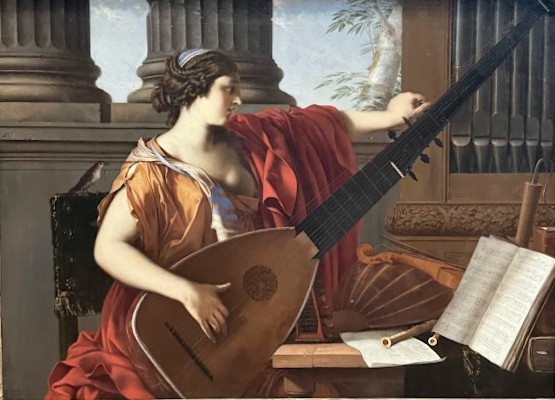
Allegory of Music (1649) Laurent de La Hyre. La Hyre was a highly influential Parisian artist and one of the founding members of the Royal Academy of Painting and Sculpture, a state sponsored academy that had full control over that was deemed “Good Art” from the Mid-17th century until the early 19th century. This is the same academy that the Impressions rebelled against in the mid-19th century.
La Hyre was commissioned to paint all 7 of the Liberal Arts for a wealthy patron. The paintings are now housed all over the world in various collections. In case you were curious, the 7 Liberal Arts are Grammar, Rhetoric, Logic, Arithmetic, Geometry, Music, and Astronomy.
Further to the right is our La Tour painting.
Penitent Magdalen
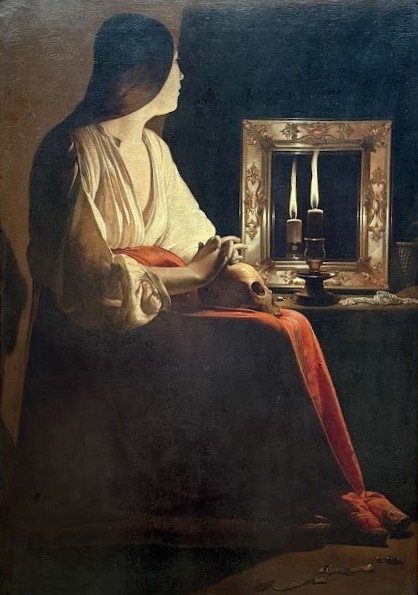
The Penitent Magdalen (c.1640) Georges de La Tour. La Tour’s Penitent Magdalen offers a quieter, more meditative vision of repentance. Stripped of excess, the scene centers on contemplation, marked by familiar symbols: the mirror of vanity, the skull of mortality, and abandoned jewelry – pleasure exchanged for piety. The Met notes this is one of at least four versions La Tour painted of the subject.
Next to Magdalen is another well known La Tour piece.
The Fortune Teller
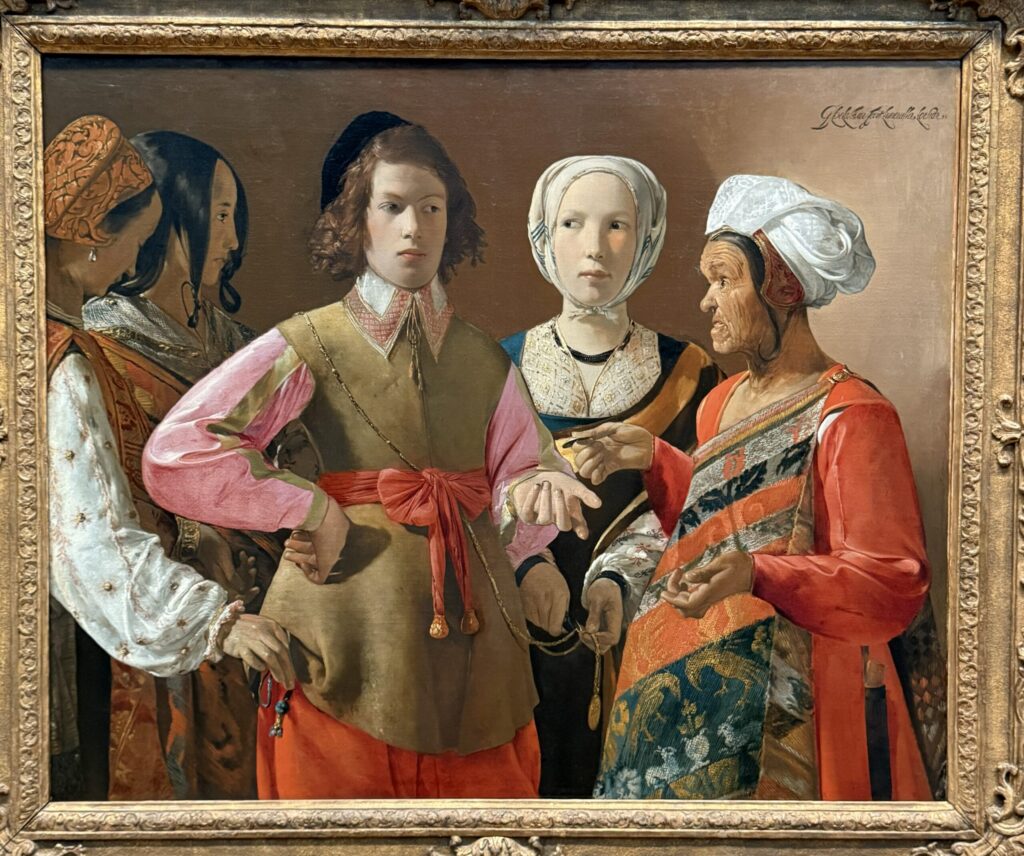
The Fortune Teller (c.1630) Georges De La Tour. The well dressed young man is hoping to gain something from having his fortune read. Instead, he is going to lose some of his valuable possessions. La Tour is cautioning us to not trust false wisdom, for it can lead to downfall.
Continuing to the right is our first piece by Simon Vouet.
A Woman Playing a Guitar
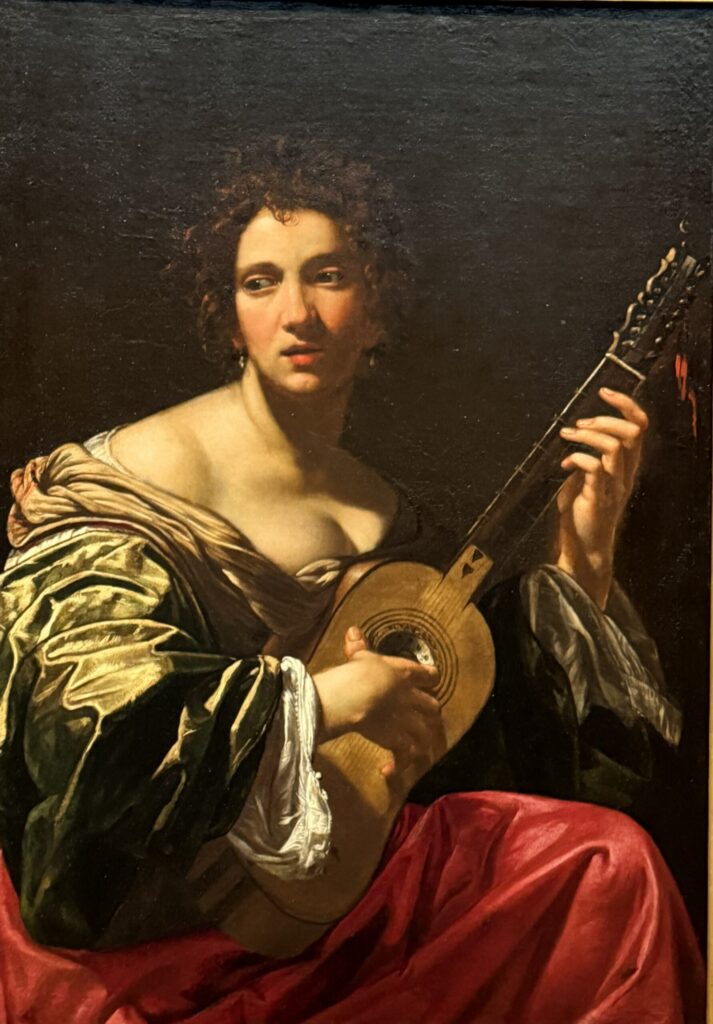
Woman Playing a Guitar (1618) Simon Vouet. This was painted while Simon was in Rome and exploring Caravaggism. The dramatic lighting, dark
color palette and extreme naturalism are traits of the followers of Caravaggio immediately after his death in 1610. Who is the woman playing the guitar? Perhaps Artemisia Gentileschi or Vouet’s wife Virginia da Vezzo? While both Artemisia and Vouet were in Rome during this time and were acquaintances, we don’t have any evidence that he actually painted her. As for his wife,
Vouet did paint her several times while in Rome, but her appearance does not match the model for this painting. Unfortunately, we do not know the identity of the woman.
To the right is a fantastic painting by another Frenchman spending time in Rome, Valentin de Boulogne.
Lute Player
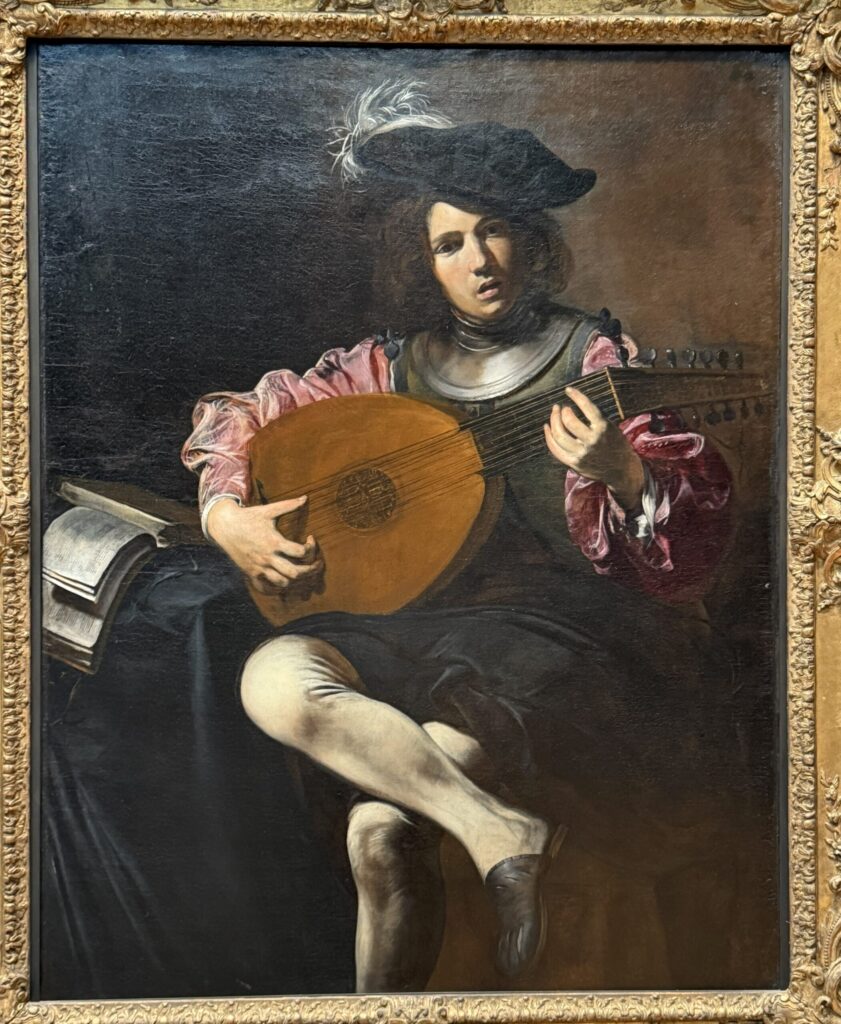
Lute Player (c1625) Valentin de Boulogne. A finely dressed solider plays the Lute for us. From the Met’s Catalogue entry: Together with Jusepe de Ribera, Valentin de Boulogne was the greatest exponent of Caravaggism in Rome, where he spent virtually his entire career, establishing a reputation among collectors for his paintings of gamblers, fortune tellers, and musicians. The Met painting is unique in showing an individual lute player—as though isolated from one of his multi-figure compositions.
On the back wall is our second Vouet, painted nearly 20 years after the “Woman playing a guitar.”
Diana Leaving for the Hunt
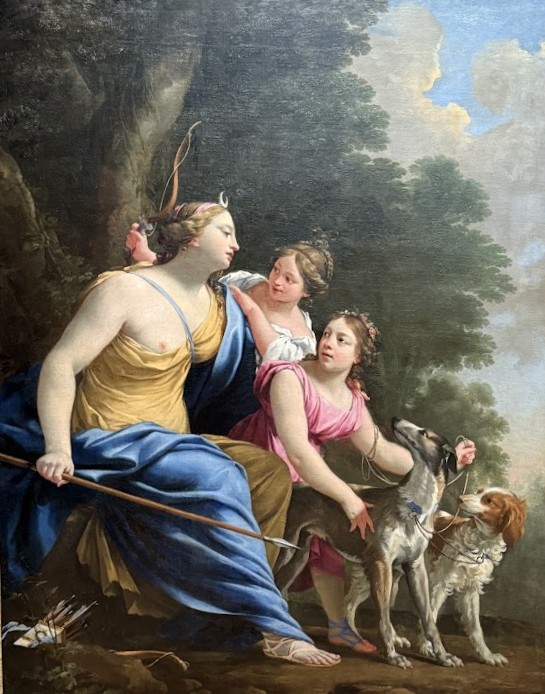
Diana Leaving for the Hunt (c.1635) Simon Vouet. I had to do a double take when I saw that the painting was by Vouet as this looks nothing like his work that we just observed from his time in Rome. Vouet presents an idealized vision of the goddess and her nymphs, accompanied by sleek hunting dogs and poised for action. There’s little grit or imperfection here: no earthy palette, no dramatic naturalism. Instead, we have a refined, cool classicism rooted in harmony, clarity, and ideal beauty. After absorbing Italian Baroque influences in Rome, he returned to Paris and deliberately reshaped them into a more classical visual language. Through his Paris workshop, this approach became foundational for a generation of French painters and helped define the emerging aesthetic of the French Academy.
Exit Gallery 623 and into 624 by the doorway next to the Vouet and turn left. We are now entering the Spanish Baroque room, full of devotional and spirital Baroque paintings.
The Supper at Emmaus
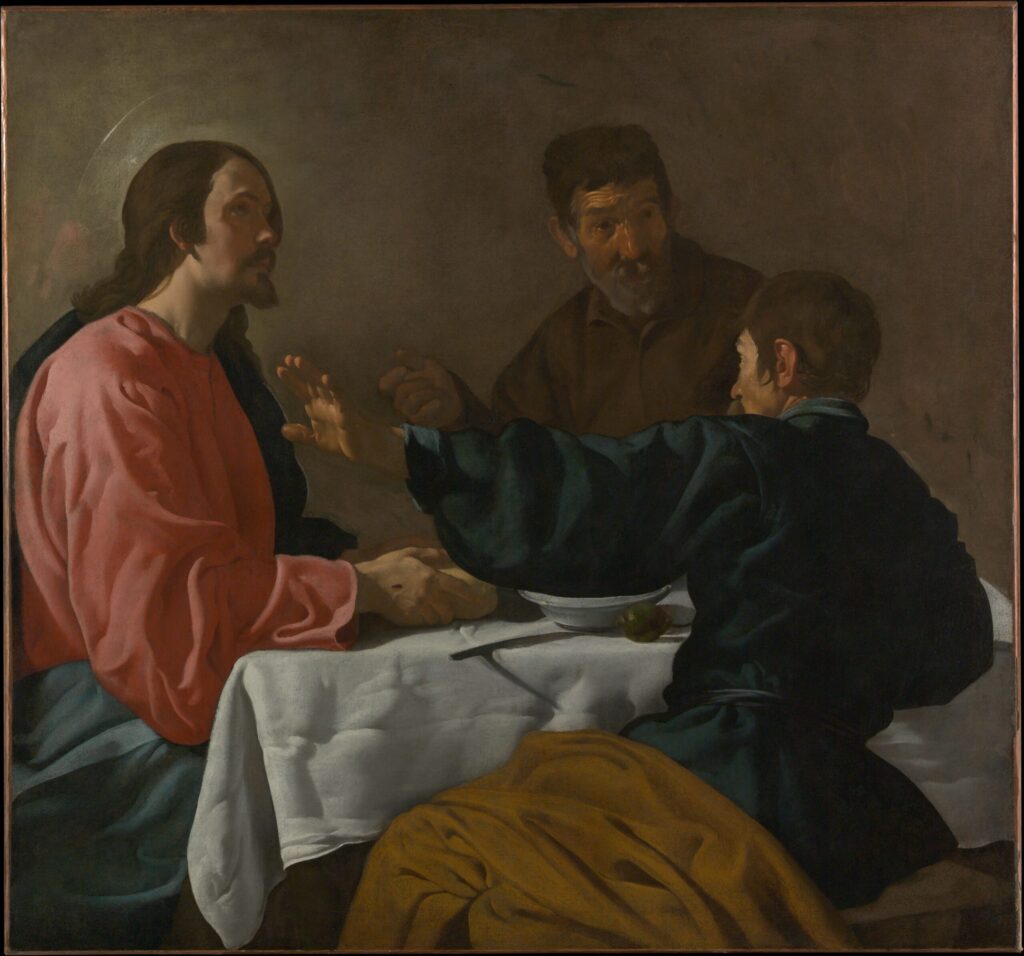
The Supper at Emmaus (c.1622) Velázquez. Velázquez was in his early 20s when he painted his interpretation of two men encountering the risen Christ. The overall tone of the painting is much more restrained when compared with Caravaggio’s version of the same subject. The gesturing man has his back completed turned away from us; we are not being invited into the painting but rather being asked to simply observe and reflect.
Continue to the right to find another masterpiece from a Spanish Baroque Master.
The Holy Family with Saints Anne and Catherine of Alexandria
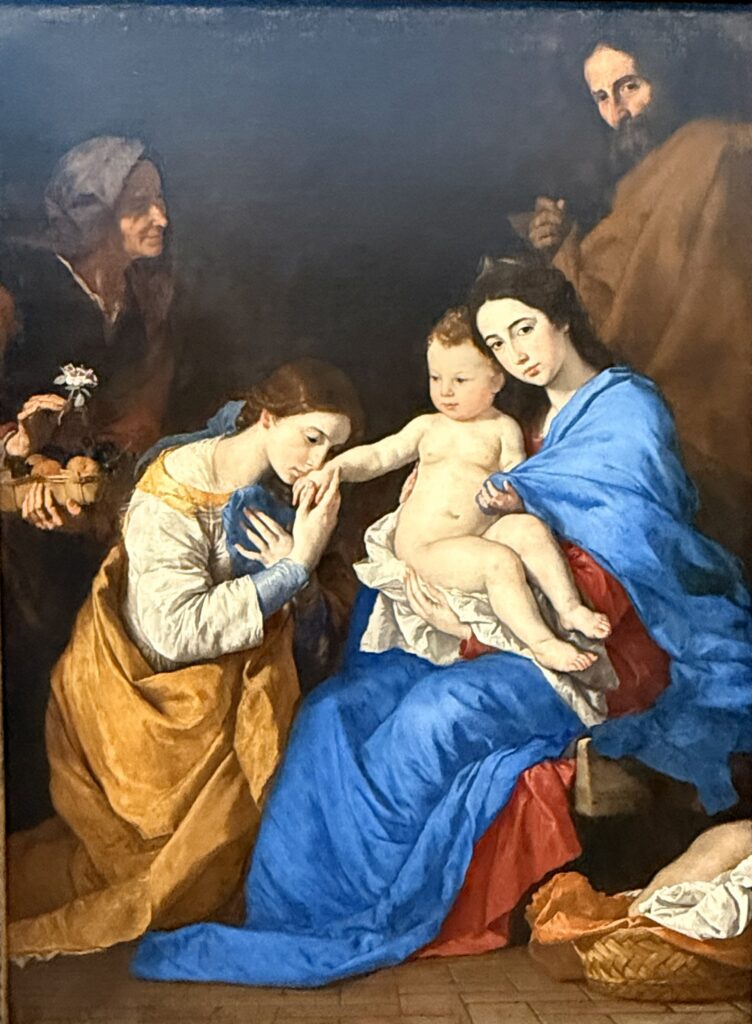
The Holy Family with Saints Anne and Catherine of Alexandria (1648) Jusepe de Ribera. Ribera combines the influence of Caravaggio and Reni in this beautiful depiction of the Holy Family with visitors. The background shows painting from models in the style of Caravaggio and the foreground shows idealized faces with a bright color palette in the style of Reni.
St. Catherine of Alexandria was especially suited to inclusion in Holy Family imagery because of her legendary mystical vision, often called the Mystic Marriage of St. Catherine. According to the Golden Legend, Catherine—an erudite Christian princess and philosopher—received a vision in which the Virgin Mary presented her to the Christ Child. Initially, Christ turned away from her, declaring that she was not yet worthy. After Catherine’s conversion and commitment to a life of chastity, Christ appeared to her again and placed a ring on her finger, signifying her spiritual marriage to Him.
Continue to the right to find another masterpiece from Ribera.
The Tears of Saint Peter
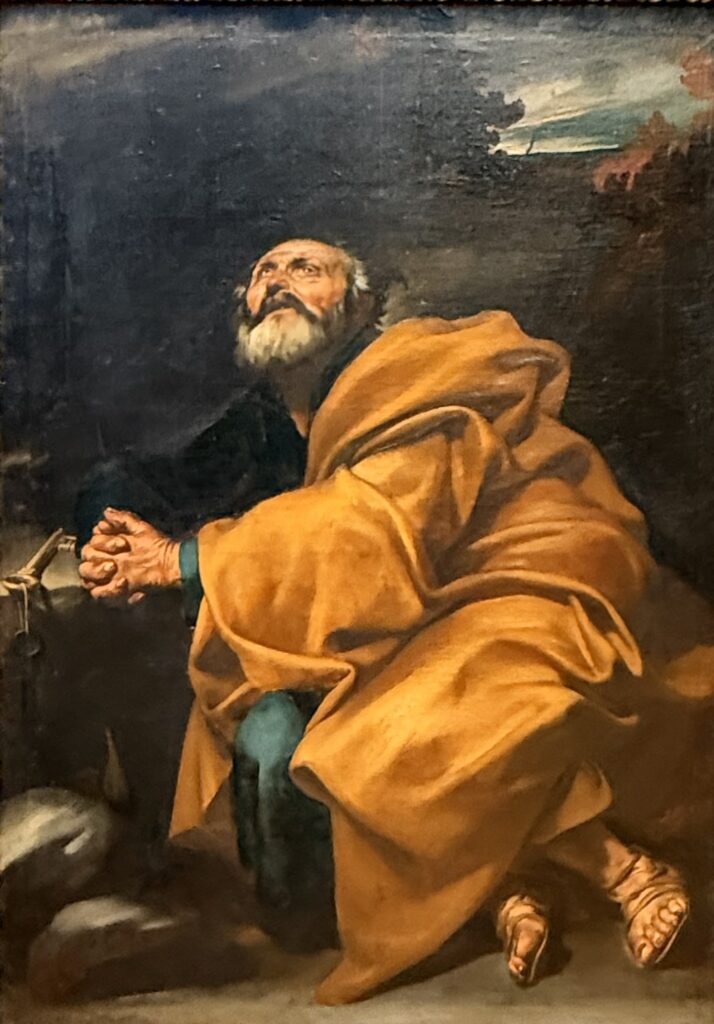
The Tears of Saint Peter (c1613) Jusepe de Ribera. Here is another treatment of the popular Counter-Reformation doctrine that penitence is a true sacrament and not simply a spiritual attitude as the Protestants argued. Emotion such as weeping is interpreted as repentance and this type of painting encouraged the viewer to reflect deeply on their own sins. We see Peter with clasped hands, his eyes up to the heavens, the weight of his guilt is obvious on his face.
Turn around and face the opposite wall to find a small but powerful piece from third Spanish Baroque master, Francisco de Zurbarán.
Agnus Dei (Lamb of God)
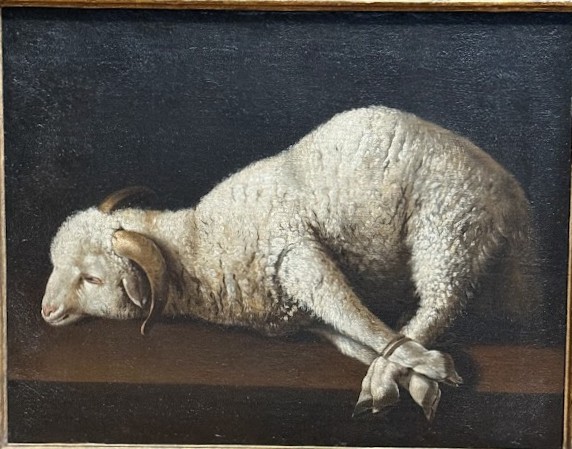
Agnus Dei (c.1635) Francisco de Zurbarán. “Lamb of God” In a museum, among many other obviously devotional pieces, this one is easy to overlook or think that it might be out of place. But if you stop and reflect on it for a minute, it becomes extremely powerful. The innocent and helpless lamb, prepared for the slaughter, has accepted its fate as Christ accepted his.
Continuing to the right, we find another fantastic piece from Zurbaran.
The Young Virgin
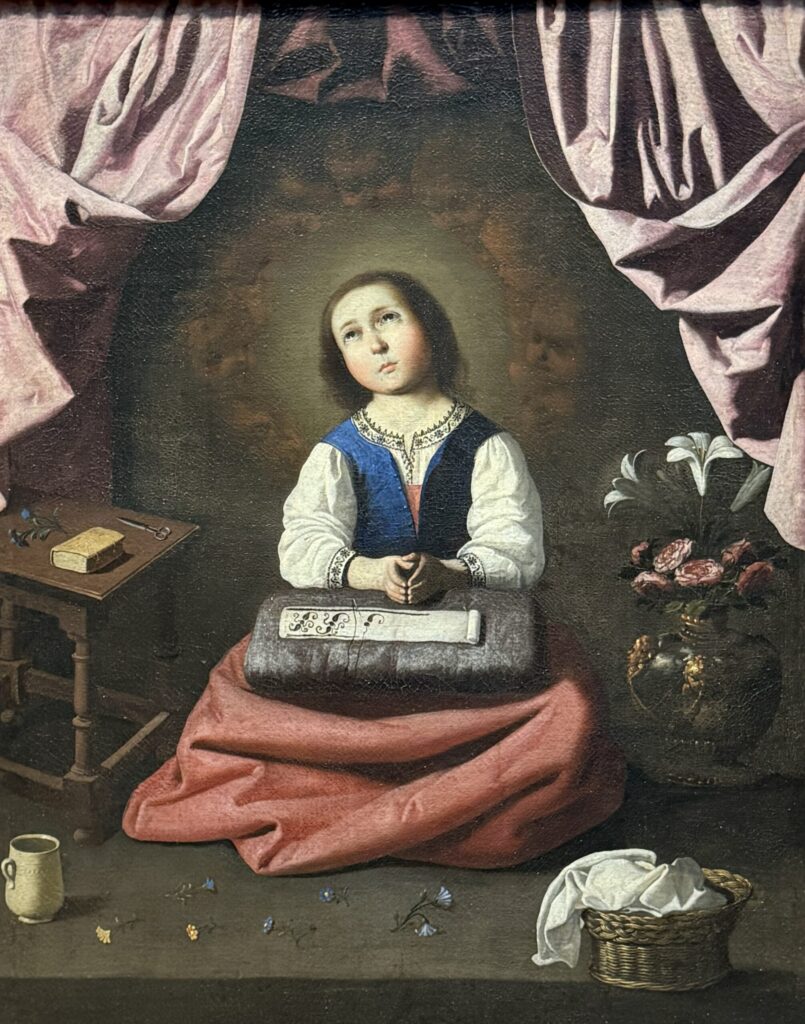
The Young Virgin (c.1632) Francisco de Zurbarán. There is so much going on in this painting, I notice something new every time I look at it. First to catch your eye of course is a very young and devout Virgin Mary, reverently turning her eyes up toward heaven. You might notice the light on her face and how there is a sort of halo around her head. If you look closely you will see that the halo is made up of cherub faces. It is also easy to miss the detailed embroidery on her neck and sleeves and the embroidery that she has taken a break from on her lap.
In the Middle Ages, the Virgin Mary was not only revered as the Mother of God but imagined in richly human detail. One of the most influential sources for this imagination was The Golden Legend, a 13th‑century collection of saints’ lives compiled by Jacobus de Voragine. Although not biblical, the book shaped Western Christian storytelling about Mary for centuries—and its echoes can still be seen in the quiet, intimate vision of Mary painted by Francisco de Zurbarán in the seventeenth century.
Continue to the right to find our last piece on this itinerary, by our fourth Spanish Baroque Master, Bartolomé Esteban Murillo.
Virgin and Child

Virgin and Child (c1670) Murillo. In this painting, we see Murillo at his most intimate: Mary cradles the infant Jesus as he momentarily turns his gaze away from nursing, a small natural gesture that makes the sacred scene feel immediate and human. Murillo’s soft modeling and warm light give the figures a gentle, approachable presence that helped make his depictions of the Virgin and Child enormously popular in 17th‑century Spain. This composition traveled far beyond Europe where to Mexico where the painter Cristóbal de Villalpando reused these exact figures in works for major cathedrals in Mexico City and Guadalajara.
Leave a Reply