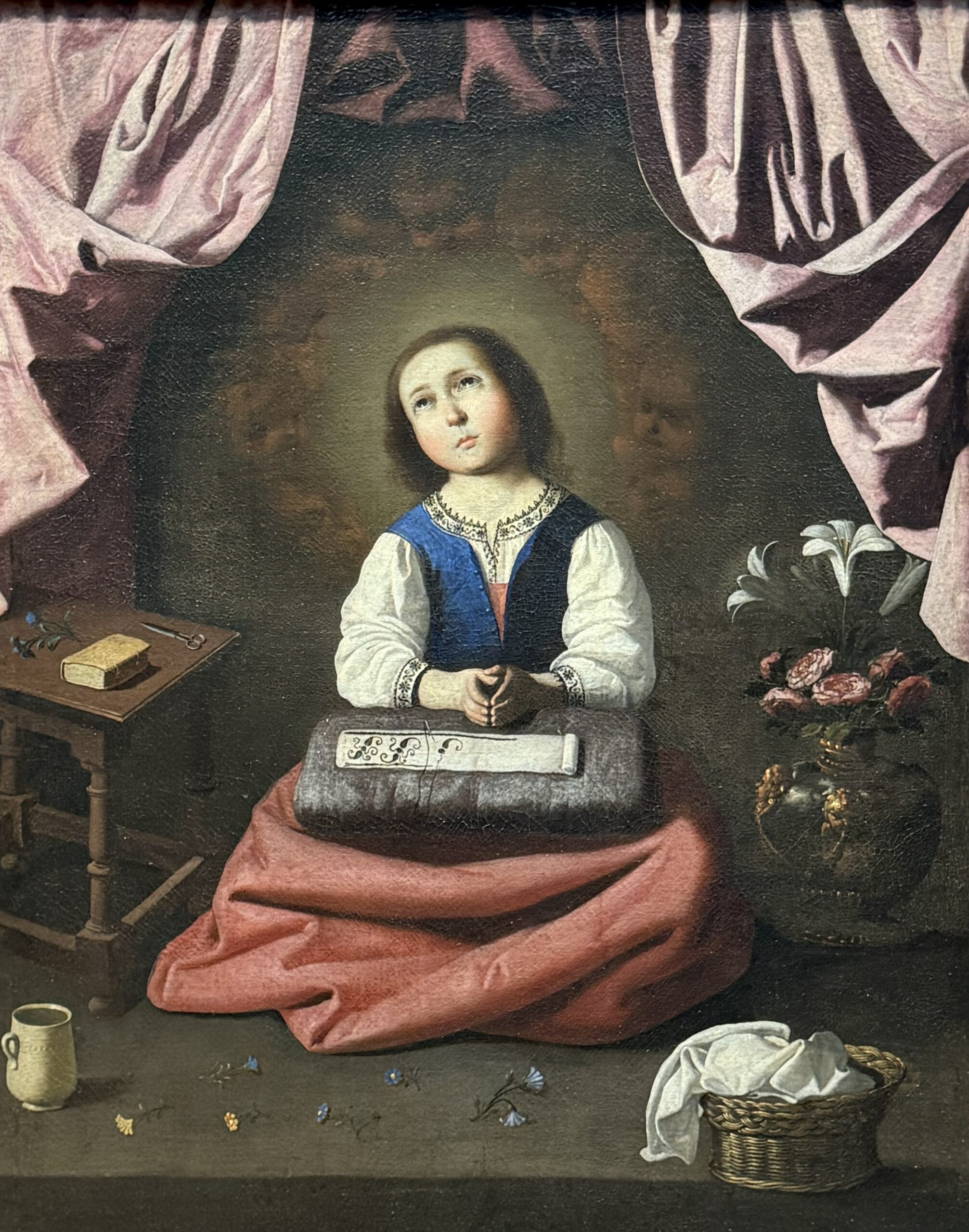
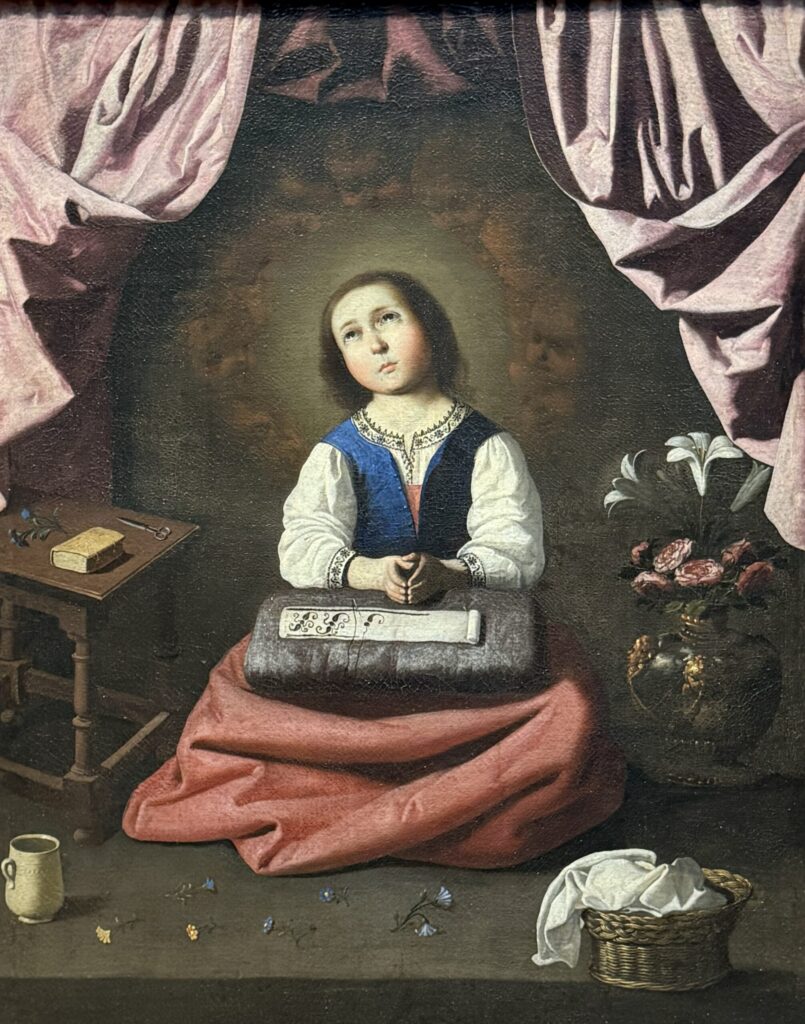
The Young Virgin (c.1632) Francisco de Zurbarán. There is so much going on in this painting, I notice something new every time I look at it. First to catch your eye of course is a very young and devout Virgin Mary, reverently turning her eyes up toward heaven. You might notice the light on her face and how there is a sort of halo around her head. If you look closely you will see that the halo is made up of cherub faces. It is also easy to miss the detailed embroidery on her neck and sleeves and the embroidery that she has taken a break from on her lap.
In the Middle Ages, the Virgin Mary was not only revered as the Mother of God but imagined in richly human detail. One of the most influential sources for this imagination was The Golden Legend, a 13th‑century collection of saints’ lives compiled by Jacobus de Voragine. Although not biblical, the book shaped Western Christian storytelling about Mary for centuries—and its echoes can still be seen in the quiet, intimate vision of Mary painted by Francisco de Zurbarán in the seventeenth century.
In The Golden Legend, Mary’s life begins long before the Annunciation. Born to the aged and previously childless Joachim and Anne, she is presented as chosen by God from her earliest days. As a young girl, Mary is dedicated to the Temple, where she lives a life of prayer, chastity, and humble labor. Drawing on earlier apocryphal traditions, Jacobus tells us that Mary supports herself by working with her hands—spinning thread or weaving textiles for sacred use. It is while engaged in this quiet, disciplined work that the angel Gabriel appears to her.
This image of Mary at work mattered deeply to medieval Christians. It presented her holiness not as distant or aristocratic, but as grounded in obedience, silence, and ordinary labor transfigured by grace. Mary is chosen not while preaching or ruling, but while sewing—her hands occupied, her spirit attentive.
Seen this way, The Young Virgin is not simply a genre scene or an exercise in realism. It is a visual meditation on preparation. Mary’s hands are busy, but her soul is already poised for assent. The painting captures the moment before history turns—the stillness in which a life has been quietly shaped for a task beyond imagining.
In both The Golden Legend and Zurbarán’s painting, Mary’s greatness lies not in spectacle, but in readiness. She is holy not because she escapes ordinary life, but because she inhabits it completely—and allows it to become the place where grace begins.
Leave a Reply