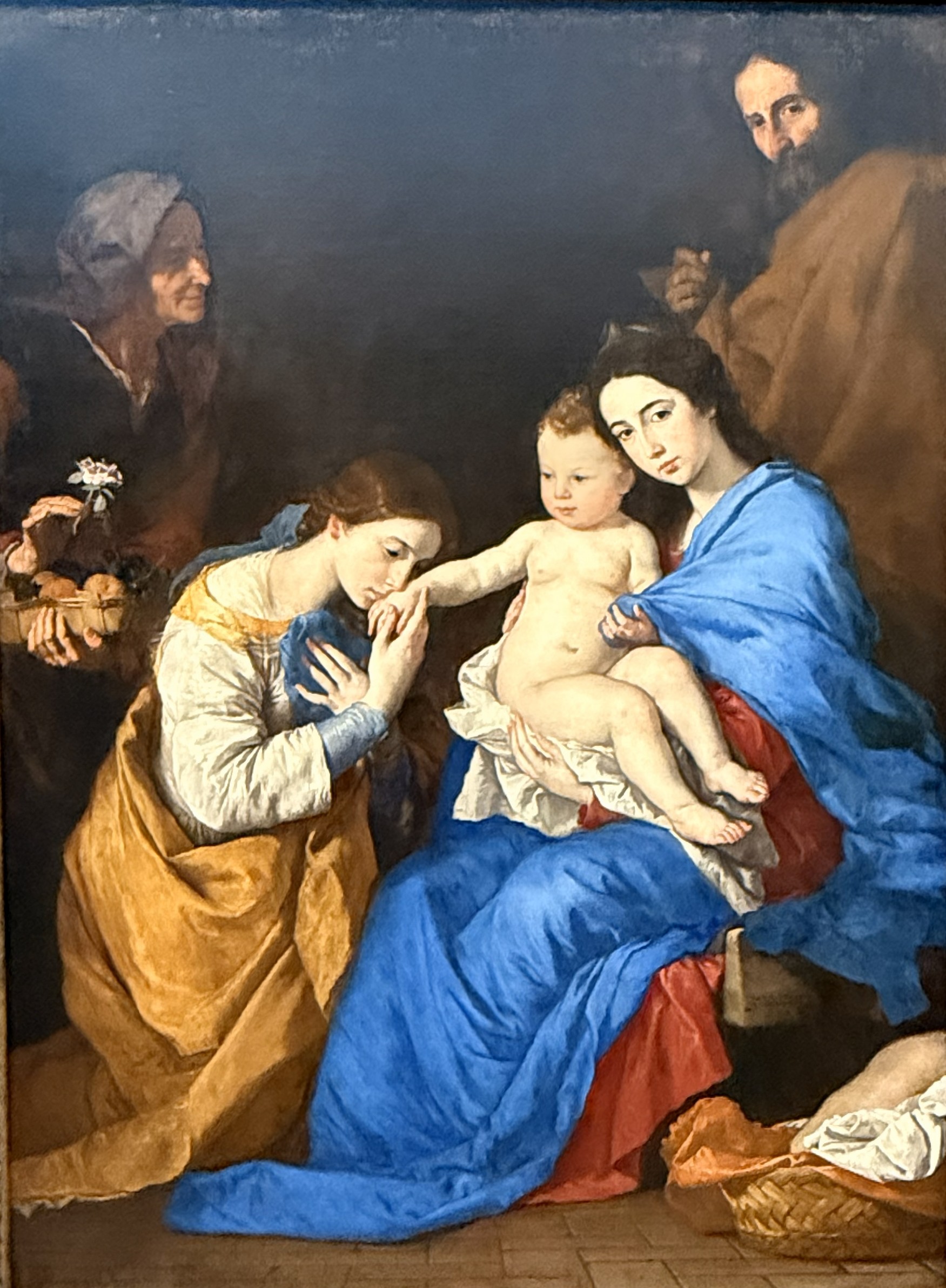
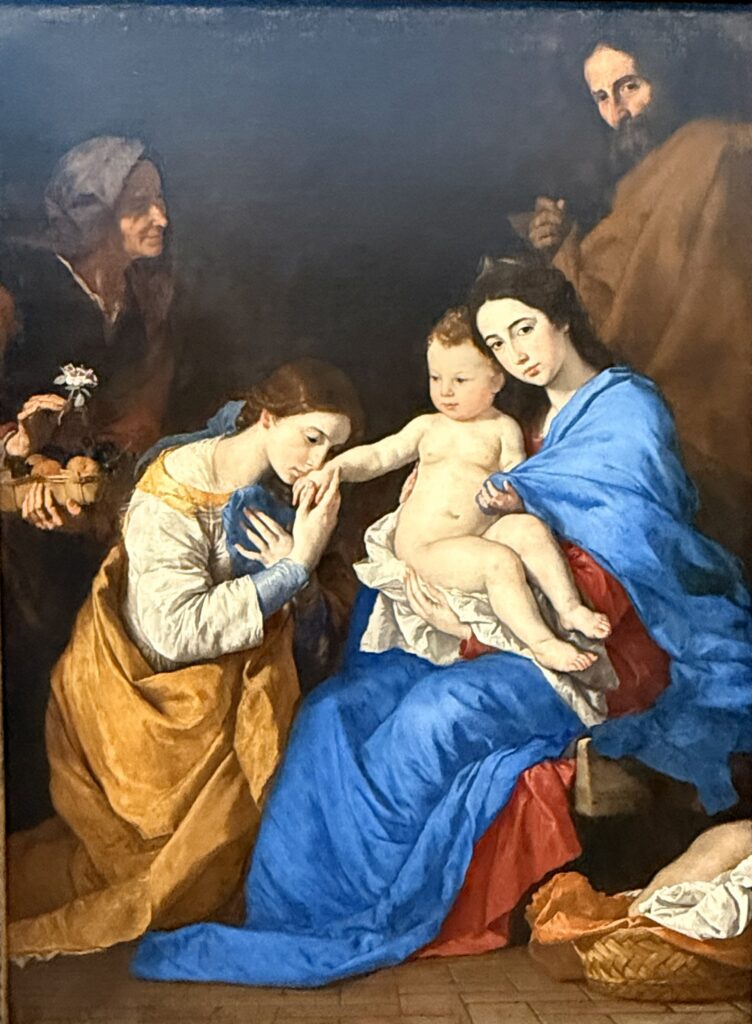
The Holy Family with Saints Anne and Catherine of Alexandria (1648) Jusepe de Ribera. Ribera combines the influence of Caravaggio and Reni in this beautiful depiction of the Holy Family with visitors. The background shows painting from models in the style of Caravaggio and the foreground shows idealized faces with a bright color palette in the style of Reni.
St. Catherine of Alexandria was especially suited to inclusion in Holy Family imagery because of her legendary mystical vision, often called the Mystic Marriage of St. Catherine. According to the Golden Legend, Catherine—an erudite Christian princess and philosopher—received a vision in which the Virgin Mary presented her to the Christ Child. Initially, Christ turned away from her, declaring that she was not yet worthy. After Catherine’s conversion and commitment to a life of chastity, Christ appeared to her again and placed a ring on her finger, signifying her spiritual marriage to Him.
This vision provided a powerful theological bridge between Catherine and the Holy Family. In devotional images, her presence is not literal but visionary: she is imagined as spiritually present before the Christ Child, often kneeling beside Mary and Joseph, gazing in rapt devotion. Baroque artists, deeply interested in interiority, mysticism, and personal piety, found this moment ideal for expressing intimate spiritual experience. The Holy Family becomes not just a domestic scene, but a site of revelation and encounter.
Including St. Catherine also allowed artists to foreground themes especially prized in the Baroque era: the union of intellect and faith (Catherine was famed for her learning), virginal devotion, and the soul’s direct relationship with Christ. Her attributes—most often the wheel or a ring—would have immediately signaled her identity to contemporary viewers, reinforcing the idea that what they were seeing was a sacred vision rather than a historical impossibility.
Leave a Reply